Just because you have a pre-existing injury does not mean that you cannot have a legal claim for financial recovery after a motor vehicle accident. Still, many insurance companies will fight your claim in settlement negotiations or in civil court in Arizona if they believe that the cause of your symptoms is a pre-existing injury.
A key issue in receiving a fair settlement after a car accident is whether any pre-existing injury you had before the crash has been worsened or aggravated because of the accident in question. In this blog post, Stone Rose Law considers the factors that go into establishing an aggravated injury settlement claim in the aftermath of a car accident.
If you have been in a car accident that has worsened a pre-existing condition, call our law offices at (480) 631-3025 to speak with an experienced personal injury lawyer in a free consultation. Or, use our online contact form.
To prove an aggravated injury after a car accident, you must show that you had a medically documented condition before the crash and that the accident made it measurably worse — not just that the condition still exists.
When negotiating to recover compensation for an aggravated injury or condition with insurance companies and defense lawyers, you will need to show that the car accident has materially worsened that pre-existing injury or condition. To do this, you must demonstrate:
Medical records of diagnosis and treatment are important in your ability to prove the elements above. Your medical history of a pre-existing condition or injury can help establish a baseline for pain, reduced work or personal function, and treatment needs, which you can then compare to the aggravated injury or condition.
Here are some of the kinds of records of pre-existing conditions that are helpful in proving their existence and severity:
Even if you did not need to treat the pre-existing condition or injury, this can still be useful as a baseline if, after the accident, you now need to treat it.
Generally, it is a good idea to seek medical attention immediately or very shortly after a motor vehicle accident or any other accident as soon as possible. If you did not have a pre-existing injury, a medical examination can help to establish the existence of an injury even if its symptoms do not show up right away.
Similarly, if you have a pre-existing condition, a medical professional can help build a foundation for how it has worsened. Insurance companies and defense attorneys will not just take your word for this. They will want to see proof. The most persuasive forms of evidence are your employment records, medical records, opinions of healthcare providers, and effects on your daily life.
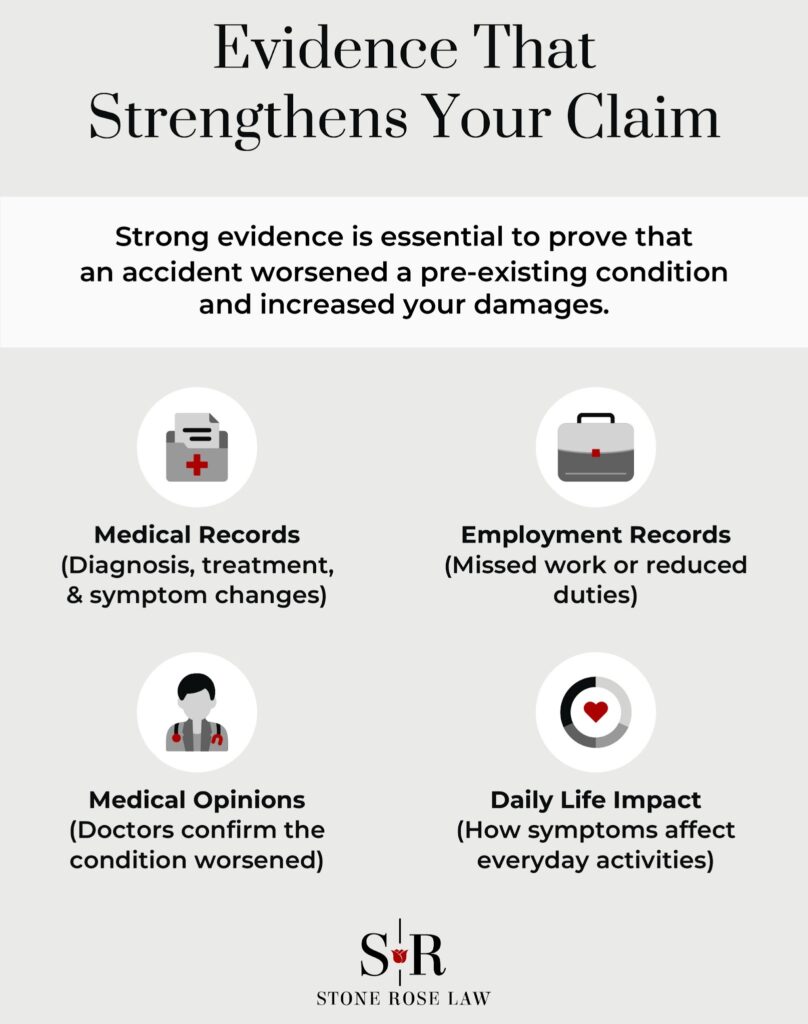
Evidence of how your aggravated injury or condition affects your ability to work can be important in increasing the settlement value of your claim. Here are some examples:
Your records of diagnosis, functional testing, work restrictions, and treatment plans are effective proof elements demonstrating how you are experiencing symptom aggravation or an increase in your treatment requirements.
Here are some examples of persuasive medical evidence for an aggravated pre-existing condition:
Your doctor’s written opinions can be powerful, persuasive evidence in establishing that your earlier injury or condition has worsened due to a recent accident. The most persuasive medical opinions will clearly state how your recent injury caused the worsening of the pre-existing condition, show how this worsening is unrelated to any natural progression of the pre-existing condition, and discuss the long-term effects and future care needs you will have.
Documenting how your aggravated pre-existing condition is affecting your ability to engage in daily life activities is more subjective than employment or medical records. But it can still be valuable when it supports these other forms of evidence. Some forms of this evidence include:
The settlement compensation you can seek for aggravation of a pre-existing medical condition or making an existing injury worse can include economic and non‑economic losses that you can link to the aggravation.
The range for the amount you can receive varies significantly (e.g. $10,000 to $500,000 or more) and depends on many factors.
Under personal injury law, the at-fault party in a car accident personal injury case cannot attempt to deny liability for your aggravated injuries or new injuries based on your increased vulnerability to these injuries because of your old injury. At-fault parties are liable to you for additional harm caused to you by the accident.
Examples include:
The greater the documented change in your ability to function or the intensity of your required medical treatment, the stronger your settlement position will be for compensation purposes.
Now that we have considered what you can do to show that the accident worsened your pre-existing injury or condition, next, we examine how insurance companies may try to minimize the value of your personal injury claim by challenging whether you are really experiencing aggravation of your past injury.
Here are some common tactics insurers use to minimize or deny aggravation of injury settlements.
Insurance companies may claim that your current injury symptoms only reflect the progression to be expected from normal aging or a degenerative condition, and that they have no connection to the accident.
The insurance company may argue that if you waited days or weeks before seeking medical care, or if you have long breaks between medical appointments or are not regularly following your treatment plan, this suggests that your current injury is not serious and that you are exaggerating your symptoms.
Insurers can seek to interpret your medical history and your medical treatment in ways that cast doubt on whether they support the existence of an aggravated injury or condition. For example:
Insurers may scrutinize your activities in the aftermath of the accident to see if they can catch you engaging in work, social, or other activities that are inconsistent with your claim that you are suffering from aggravated injury symptoms. This can include monitoring your social media accounts or even hiring a private investigator to follow you.
Insurers will look to see if your treatment for your old injury has changed in ways that they can argue that you have escalated your treatment in an excessive way, like suddenly switching from conservative to invasive treatments or increasing your treatment frequency without providing an adequate explanation.
Aggravated pre-existing conditions after a car accident are like other personal injury legal claims in that they usually settle without going to trial. For personal injury settlements with these kinds of claims, the key issue is establishing the existence of the old injury nd proving how the recent accident has worsened its symptoms and effects on your life.
Strong documentary evidence in the form of new and increased medical costs, negative effects on your employment, and doctors’ opinions linking the aggravated injury or condition to these consequences are usually the most influential factors when you seek compensation based on aggravation.
At Stone Rose Law, our experienced personal injury attorneys know the importance of gathering and organizing your supporting evidence to tell a compelling “before-and-after story” that overcomes insurer doubts and objections, so you can receive fair compensation. To learn more about how one of our car accident attorneys can help you, call our legal team at (480) 631-3025, or reach us online at any time to schedule a free case evaluation.