Bladder cancer that is connected to your military service can qualify you for a bladder cancer VA disability rating.
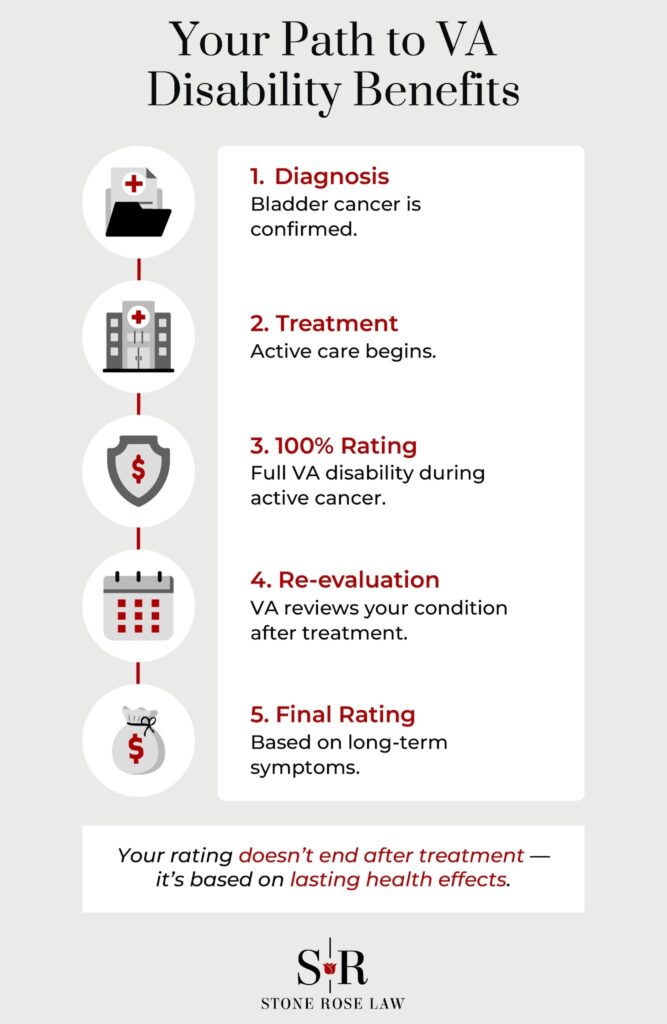
The U.S. Department of Veterans Affairs (the VA) provides a 100% disability rating for service-connected bladder cancer while it is active, or you are undergoing treatment for it. After your treatment is complete, the VA can still provide you with disability compensation based on residual symptoms like urinary incontinence or kidney failure.
In this article, we examine how the VA evaluates bladder cancer as a compensable disability, how to file a claim with the VA for bladder cancer VA disability benefits, the disability ratings connected with bladder cancer, and what you can do if the VA denies your initial bladder cancer claim.
Stone Rose Law represents disabled veterans pursuing bladder cancer VA disability benefits as a core area of our law practice.
Our VA disability lawyers have many years of combined experience helping military veterans nationwide obtain the fair compensation they are entitled to under the law for service-connected disabilities, and we represent veterans who need to overcome initial claim denials.
We provide legal representation to veterans with all types of VA disability claims, including those involving bladder cancer. We will help you gather and organize the evidence you need to support your claim, prepare it, submit it, and monitor its progress until the VA issues a final decision.
You can call us at (480) 498-8998 to set up a free consultation with an experienced VA claims attorney, or, if you prefer, use our online contact form.
To receive a bladder cancer VA disability rating, you must be able to show the VA that your claim is related to your time in the military. This is known as establishing a service connection.
The VA recognizes three ways to establish a service connection for bladder cancer benefits: presumptive service connection, direct service connection, and secondary service connection.
A direct service connection depends on your ability to show the VA that all three of the following are true:
1. You have a current medical diagnosis of bladder cancer from a qualified medical practitioner.
2. Your bladder cancer was caused by an in-service event or exposure.
3. A causal nexus exists that links the in-service event or exposure to your current bladder cancer symptoms.
You prove these three elements with documentation that you submit with your bladder cancer VA disability claim. Examples of evidence that the VA finds persuasive include:
If you served in the military in certain places and date ranges, the VA will presume that the medical nexus exists between your military service and your bladder cancer symptoms. This can make it much easier to receive a bladder cancer VA disability rating because you do not have to prove this connection yourself.
The table below summarizes how you may qualify.
| Exposure & Service | Eligibility Criteria | Evidence You Need | Notes |
|---|---|---|---|
| Herbicides (Agent Orange) | You served in Vietnam, the Korean DMZ, or a qualifying area of operation, with toxic exposure during specified dates. | Proof of service in the location/time (e.g., DD-214, ship logs).Current medical diagnosis of bladder cancer. | Bladder cancer was added in 2021 |
| Camp Lejeune Water Contamination | You served at least 30 days at Camp Lejeune, North Carolina, between August 1, 1953, and December 31, 1987 | Service records proving 30 or more days at Camp Lejeune in the covered periodBladder cancer diagnosis (past or current) | |
| Burn Pit Exposure | You served on or after August 2, 1990, in the Southwest Asia theater (Gulf War Middle East combat zones), or on or after September 11, 2001, in Afghanistan or specified countries (e.g., Djibouti, Syria, Somalia) | Service personnel records showing duty in covered locations and datesBladder cancer diagnosis | Bladder cancer was added to the burn pit presumptive list in January 2025If you were previously denied benefits, then refile under the PACT Act |
| Ionizing Radiation | You participated in a defined radiation-risk activity (e.g., 1945–1962 atomic tests, or 1970s Palomares/Thule cleanup) | Official records of participation in nuclear tests or qualifying mission (DoD radiation registry, orders)Diagnosis of bladder cancer |
Some other kinds of disabilities that the VA recognizes as service-connected can cause you to develop bladder cancer or can aggravate an existing condition. In these cases, the medical nexus you must show is between the pre-existing disability condition and the onset or aggravation of the bladder cancer as a secondary condition.
An example of a pre-existing disability condition that can support a secondary claim for bladder cancer is when you have another form of cancer for which you are receiving radiation or chemotherapy. This therapy leads you to develop bladder cancer.
Or, you have a service-connected autoimmune disease, and the immunosuppressant medications you are taking to treat it led to the onset of bladder cancer.
Total Disability Based on Individual Unemployability, or TDIU, enables some qualifying veterans to receive the equivalent of 100 percent disability benefits even if their actual VA disability rating does not rate 100 percent.
While your bladder cancer is active or you are undergoing treatment for it, you will receive a 100% disability rating, so this makes TDIU a non-consideration. But once the VA considers you for a residual disability rating, TDIU may apply.
To receive schedular TDIU benefits, you must meet the following criteria:
So, as we will see below, if you have a VA rating for severe voiding dysfunction or severe renal dysfunction, either of these is a 60% VA disability rating. If this is your only VA disability and you cannot gain or keep substantially gainful employment, you may qualify for schedular TDIU, and your effective VA rating will be 100%.
In some cases, if you cannot qualify for schedular TDIU above, the VA may consider you for extra-schedular TDIU. To receive this consideration, your bladder cancer disability must keep you from having substantially gainful employment, and the VA will consider the following factors that apply to you:
When you file an initial bladder cancer VA disability claim, the VA will often schedule you for a compensation and pension (C&P) exam. The VA may do this for multiple reasons:
During your C&P exam, a VA Examiner will usually ask you questions about things like your urinary frequency, urinary incontinence, any use of catheters or pads, or kidney issues.
Upon completion of the C&P exam, the examiner will prepare a report for the VA to use in its decision of whether to approve your benefits claim.
Once you have established a service connection to your bladder cancer through any of the three paths above, then the VA may assign you a disability rating. The rating you receive depends on the following factors.
During the period your bladder cancer is active, or while you are undergoing surgery, antineoplastic chemotherapy, radiation, or other treatment, the VA will assign you a 100% disability rating under Diagnostic Code 7528 (38 C.F.R. § 4.115b). This rating continues for six months after your last treatment.
Once six months pass after your last cancer treatment, the VA will schedule you for another C&P exam to assess any residual disabilities that will be the basis of your residual disability rating.
Bladder cancer and cancer treatments can lead to lingering disability symptoms, also known as VA bladder cancer residuals, that come in two forms: voiding dysfunction (issues with urination) and renal dysfunction.
If both forms of dysfunction are present, then the disability rating the VA assigns you will be based on which of them is the predominant one.
The table below summarizes common residual conditions for which the VA provides compensation.
| Condition / Residual | VA Disability Rating | Notes |
|---|---|---|
| Severe voiding dysfunction | 60% | Requires the use of an appliance or absorbent materials that must be changed more than 4 times per day (e.g., post-surgery incontinence requiring constant management) |
| Moderate voiding dysfunction | 40% | Requires absorbent materials changed 2–4 times per day (significant but not total incontinence) |
| Mild voiding dysfunction | 20% | Requiring absorbent materials changed <2 times per day (occasional leakage) |
| High urinary frequency | 40% | Daytime voiding intervals of less than one hour, or waking 5 or more times per night to urinate |
| Moderate urinary frequency | 20% | Daytime voiding intervals of one to two hours, or waking three or four times per night |
| Obstructed voiding | 30% | Urinary retention that requires intermittent or continuous catheterization |
| Severe renal dysfunction | 60% to 100% | Chronic kidney diseaseSevere renal dysfunction is rated at 60%–100%, depending on severityLesser renal dysfunction ratings also exist under 38 C.F.R. § 4.115a |
| Erectile dysfunction secondary to bladder surgery or nerve damage | 0% + SMC-K special monthly compensation | ED is typically rated 0% but qualifies for Special Monthly Compensation (SMC) for loss of use of a creative organ. |
The VA does not always approve initial bladder cancer VA disability claims. This can happen because the VA concludes that your supporting documentation is insufficient, you did not attend a scheduled C&P exam, or, in some cases, the VA may make a mistake.
Regardless of the reason, you can request reconsideration of a denial decision. These include filing a supplemental claim, requesting a higher-level review, or requesting a board appeal review by a Veterans’ Law Judge.
Each of these appeal paths has its best uses, depending on your circumstances. The table below summarizes their specific characteristics.
| Review Option | Best Used When | Can You Introduce New Evidence? | Estimated Timeframe |
|---|---|---|---|
| Supplemental Claim | You have new and relevant evidence to add, like new medical records, a nexus letter, or additional written lay testimony that addresses the VA’s reason for denial. | Yes (Required)You must submit or identify new and relevant evidence that the VA will consider in a fresh review. | Four or five months |
| Higher-Level Review | You believe the VA erred in its initial decision, or that all evidence has already been provided and no further documents are needed.Good for clear mistakes on your service connection, disability rating, or effective dates of disability | NoThe VA will decide based on the same evidentiary record, although you can point out evidence or regs that the initial review ignored or misapplied. | Four or five months |
| Board Appeal (VA Form 10182) | You want a Veterans Law Judge to review your case. Useful in complex claims, or when other reviews did not fix the error, or if you want a hearing or the ability to submit more evidence | PossiblyDepends on the kind of appeal you choose.Some appeals do not allow additional evidence, while others allow a limited time to introduce new evidence. | One to three years |
VA benefits claims can be complex to prepare, and the VA bladder cancer rating system can be confusing.
A bladder cancer VA disability claim has two distinct stages and turns on the difference between voiding and renal dysfunction. An experienced Stone Rose Law lawyer can guide you through the VA disability claim process for bladder cancer, save you time, and give you confidence as you prepare and submit your initial claim.
We can also help you to prepare for any C&P exam the VA may request.
Bladder cancer can take a long time to treat, and its residual disabilities can be long-lasting. This makes it important to claim as much as possible in your VA benefits, not only for monthly compensation but also for other healthcare benefits the VA offers.
To find out more about how Stone Rose Law can help you with your initial claim, or to revive a denied claim for a VA disability rating for bladder cancer, call us today at (480) 498-8998 or reach us online to communicate with one of our experienced attorneys in a free consultation.