
The Arizona Employment Protection Act (AEPA) explains when an at-will termination crosses the line into an unlawful firing. It sets clear rules for employees and employers, and it tells you which claims are allowed under Arizona employment law and which are not.
Arizona is an at-will state, but at-will does not mean that anything goes. The AEPA limits an employer when the employment relationship is cut off for reasons that violate an Arizona statute, public policy, or a valid written contract that restricts termination.
If you believe your termination violated the AEPA, call Stone Rose Law at (480) 535-9003 to speak with an employment lawyer about your rights and options.
At-will employment allows either side to end the job at any time for any lawful reason. The AEPA carves out exceptions, allowing a person to bring a claim when a termination is tied to an illegal order, a protected disclosure, the exercise of Arizona statutory rights, or a breach of a written contract that changes at-will status.
This balance is the core of Arizona labor law. It protects an employer’s ability to manage the company, but it also protects employees’ rights when they refuse to break the law or when they rely on a signed agreement that sets limits and procedures.
The AEPA is codified in the Arizona Revised Statutes (ARS) § 23-1501. The statute defines which wrongful termination claims can proceed, and it limits claims that fall outside its provisions or that are not tied to an Arizona law or a written contract.
The statute recognizes four routes to a claim.
First, an employee is protected when they refuse to commit an act that would violate an Arizona statute or the Arizona Constitution.
Second, an employee is protected when they disclose, in good faith, a violation of Arizona law to a supervisor or a public agency.
Third, an employee is protected when they exercise a right granted by an Arizona statute, such as filing a workers’ compensation claim, honoring a subpoena, or reporting wage issues to the Industrial Commission.
Fourth, an employee can sue when a written contract limits at-will termination and the employer violates that agreement.
The AEPA focuses on Arizona law. Complaints about company policy, without a link to a statute, are usually not covered, and general unfairness, favoritism, or poor management does not create an AEPA claim unless another law was violated or a written contract was breached.
The AEPA also does not replace other employment laws. Discrimination based on sex, national origin, disability, age, or religion is usually handled under Title VII of the Civil Rights Act, the Americans with Disabilities Act, or the Age Discrimination in Employment Act, not under the AEPA.
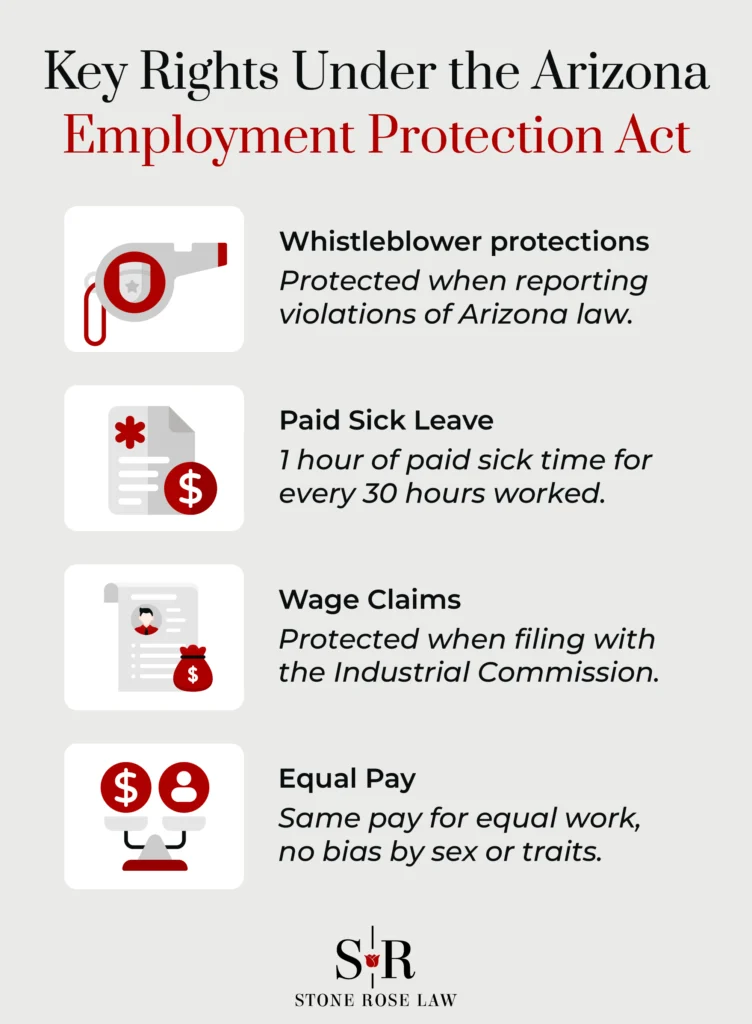
Arizona workers can report unsafe working conditions or occupational safety hazards without being punished for speaking up. If a person discloses what they reasonably believe is a violation of an Arizona statute, such as a safety rule or wage law, and the employer responds with disciplinary action or termination, the disclosure can support an AEPA claim.
Whistleblowing can be internal to a manager or external to a public agency. The key is good faith and a clear link to Arizona law. This is why the report should identify the statute, describe the practice, and explain how the violation affects hours, pay, or risk in the workplace.
Arizona’s earned paid sick time law gives most employees the right to accrue paid time. Many workers earn one hour of sick leave for every thirty hours worked, and they can use the time in blocks or consecutive hours consistent with company procedures and the statute.
If an employee uses earned paid sick time and the employer responds with a write-up, a loss of shifts, or termination, the timing can matter. The Industrial Commission of Arizona enforces regular payday rules, minimum wage, and wage claims, so if a worker files a proceeding for unpaid wages and is fired soon after, that sequence can support both a wage claim and an AEPA retaliation claim.
Arizona law allows drug testing programs, but employers need to apply them in a neutral and confidential way. Policies should describe verification steps, access limits, and how results are used. Additionally, the company must comply with confidentiality and data security rules so that private information is not disclosed to people who do not need it.
Drug testing should not target one person or a protected group, such as the opposite sex or a national origin group, and it should not be used as a pretext for firing someone who reported a violation. When testing is used to punish a protected disclosure, or when a disclosure triggers sudden disciplinary action, the pattern can serve as evidence in an AEPA claim.
The AEPA upholds breach of contract claims for written agreements limiting termination, such as a signed offer letter allowing termination only for cause or a fixed-term contract with a grievance procedure, which may override at-will employment and bind the employer to follow the contract’s terms.
Handbooks and policy manuals usually include an at-will disclaimer, so they rarely create enforceable contracts. A collective bargaining agreement can set rules on classification, pay, benefits, and discharge procedures, and the company must respect that agreement just as it must respect any other written contract covering the employment relationship.
Private employers in Arizona often use the E-Verify program to confirm employment eligibility. Verification must be done the right way and within required time frames, and it cannot be used to discriminate against workers based on national origin, citizenship status, or other protected traits.
Arizona employment laws mandate earned paid sick time, wage claim procedures, and regular paydays. Federal and local laws, including the Family and Medical Leave Act, Fair Labor Standards Act, and OSHA, provide additional protections for leave, wages, hours, and safety, which may intersect with an AEPA claim if termination follows a protected act.
Equal pay rules require equal pay for equal work within the same establishment when jobs need the same skill, effort, and responsibility under similar working conditions. Pay differences should be based on seniority, merit, quantity or quality of production, or another neutral factor, not on protected traits such as the opposite sex.
Classification practices affect wages, benefits, and hours, and they need to be applied fairly. When a worker discloses that employees in the same classification are paid less for the same quantity of work and then faces termination, that disclosure and the timing can be part of an AEPA claim, and it can be paired with federal or state discrimination claims.
Constructive discharge happens when conditions are so bad that a reasonable employee would feel compelled to resign. Arizona expects written notice of the intolerable working conditions and a reasonable chance to fix them when it is safe to give notice. Thus, a short letter or email that describes the conduct and asks for a cure is important.
If the company ignores the notice or the conduct continues, the employee’s resignation can be treated like a discharge for claim purposes. The facts matter here, including the duration of the conduct, whether the employer knew, and whether there was any suitable work alternative that would have allowed the person to stay.
Public employees have separate remedies and are excluded from AEPA claims.
Private employers must comply with the AEPA and with other Arizona statutes on wages, sick leave, and verification, and they cannot punish a person for using these rights.
If a claim involves discrimination, harassment, or retaliation based on a protected trait, a charge usually must be filed with the Arizona Civil Rights Division or the Equal Employment Opportunity Commission before a lawsuit.
Filing with the correct agency preserves remedies and keeps the legal process on track.
AEPA cases turn on evidence and timing. Useful records include dated complaints that name the statute, emails or messages that show disclosure and receipt, and performance records before and after the disclosure, which help test whether the stated reason for termination is true.
Deadlines are strict. Many AEPA wrongful termination claims have a one-year limit for filing suit in Arizona court, while civil rights claims often require filing a charge within one hundred eighty to three hundred days. Wage claims can involve different agency procedures and penalties depending on the amount owed and the company’s practices.
The AEPA is one part of a larger system. Title VII covers discrimination based on race, color, religion, sex, and national origin, the ADA covers disability, the ADEA covers age, and OSHA covers occupational safety. Thus, a single termination can involve both an AEPA claim and claims under federal statutes.
Other provisions touch on the same facts, such as earned paid sick time rules, medical leave under the federal Family and Medical Leave Act, and wage rules that apply to hours, overtime, and regular paydays. When an employer violates one set of rules and then fires the person who complained, the combined violations can affect remedies, penalties, and compensation.
Employers often say the termination was for performance, attendance, or a rule violation with no link to the protected act. They may point to a policy manual, argue there was no disclosure, or say the person refused to do suitable work, so the discharge was unrelated to any law or proceeding.
The best response is a clean record. A short timeline that ties the disclosure to later disciplinary action, matched with copies of complaints, pay records, schedules, and witness names, makes it easier to prove that the protected act caused the termination and that the company violated the statute.
Employees can protect their rights with a few simple steps. Put concerns in writing, identify the Arizona statute at issue, keep copies, and follow internal procedures. This way, you can show that you gave the company a fair chance to comply.
Employers can reduce risk by training managers, following written procedures, applying drug testing and confidentiality rules evenly, and documenting decisions that affect classification, hours, and pay. A fair process shows respect for the law and helps the company defend a claim if litigation is filed.
If your termination followed a protected report, a refusal to violate the law, the use of earned paid sick time, or breached a written contract, you may have a claim under the Arizona Employment Protection Act.
Call Stone Rose Law at (480) 535-9003 to speak with an employment lawyer about compensation, protection, and next steps under Arizona law.