
Sexual harassment against men in the workplace is unlawful when the conduct is tied to sex, gender, sexual conduct, or sexual stereotypes and is severe or pervasive enough to affect the terms and conditions of employment.
Men can experience workplace sexual harassment from supervisors, managers, coworkers, customers, clients, vendors, or other people connected to the job.
Sexual harassment in the workplace is not limited to one gender. A man can be the victim of harassment by a woman or by another man.
The harasser does not have to be motivated by sexual desire, and the victim does not have to prove that the perpetrator was attracted to him. The central issue is whether the conduct was unwanted, unwelcome, and connected to sex or gender in a way the law recognizes.
To talk with a Stone Rose Law employment attorney about your case today, call us at (480) 630-2765 or use our online contact form.
Sexual harassment against men can involve a female harasser, a male harasser, or multiple employees participating in the conduct.
A supervisor may pressure a male employee for dates or sexual contact. A coworker may make repeated sexual comments about a man’s body. A group of employees may target a man with sexual jokes, unwanted touching, or comments about whether he is “man enough” for the workplace.
The law does not require sexual harassment to fit a narrow script.
Male sexual harassment may involve unwanted advances, sexual advances, sexual comments, explicit messages, pressure for sexual favors, or unwanted touching. It may also involve insults or conduct based on gender stereotypes, sexual orientation, perceived masculinity, or assumptions about how men should respond to sexual attention.
Sexual harassment against men is more common than many workplace discussions suggest. In recent years, male victims have accounted for roughly 16% to 20% of sexual harassment complaints filed with the Equal Employment Opportunity Commission, often called the EEOC.
However, that number likely understates how often male sexual harassment in the workplace occurs.
Underreporting is a major issue in workplace sexual harassment cases, especially among male victims. As a result, many employees never report the conduct to an employer, HR department, government agency, or attorney.
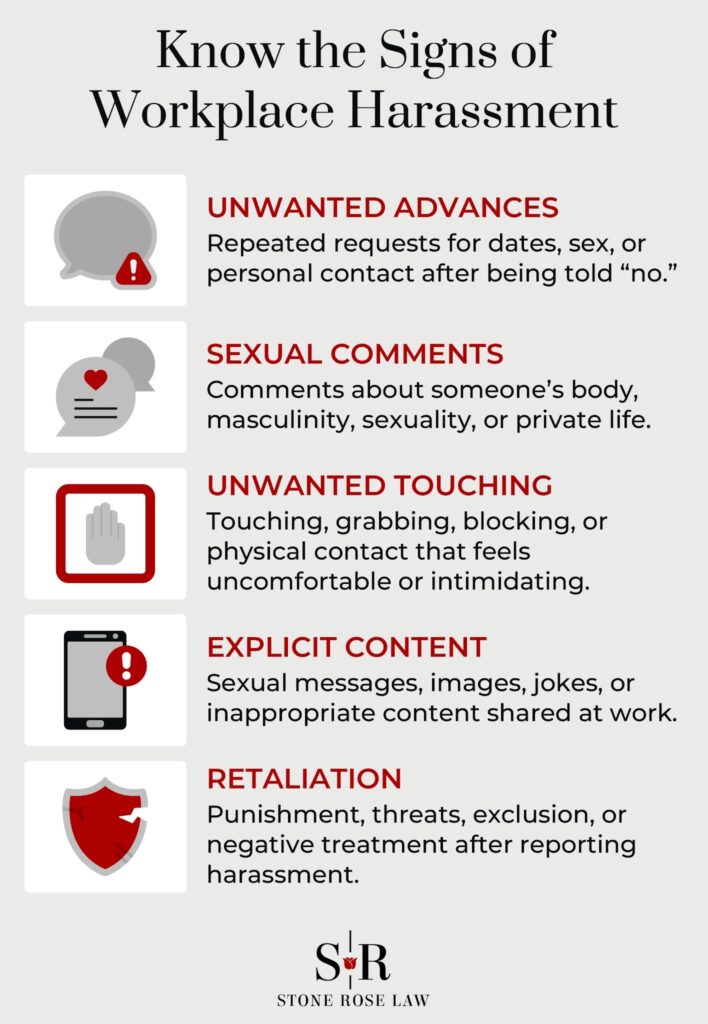
Male sexual harassment in the workplace can take several forms. Some cases involve direct sexual pressure. Others involve repeated verbal harassment, sexualized insults, offensive images, or physical conduct that creates a hostile work environment.
Common examples include:
A single severe incident may be enough in some cases. More often, hostile work environment claims involve repeated conduct that becomes severe or pervasive over time.
Quid pro quo sexual harassment occurs when job benefits or job consequences are tied to sexual conduct. This type of harassment often involves a supervisor, manager, or another person with authority over the employee’s work.
A quid pro quo claim may arise if a supervisor suggests that a male employee will receive a promotion, raise, better schedule, preferred assignment, or continued employment in exchange for sexual contact. It may also arise if the supervisor threatens discipline, termination, bad shifts, or lost opportunities because the employee rejects sexual advances.
The employee does not have to accept the demand for the conduct to matter. A rejected demand can still support a sexual harassment claim, especially if the employer then takes action against the employee or allows the pressure to continue.
A hostile work environment exists when unwelcome conduct based on sex, gender, or sexual conduct is severe or pervasive enough to alter the conditions of employment and create an abusive work environment. This standard looks at the total workplace context, not just one comment in isolation.
For men, a hostile work environment involves repeated sexual jokes, unwanted sexual advances, sexual comments, unwanted touching, explicit messages, or insults tied to masculinity, sex, or gender stereotypes. It may also involve conduct that other people try to dismiss as banter, teasing, or horseplay.
Workplace culture does not excuse harassment. An employer cannot avoid responsibility simply by saying that everyone jokes that way, that the employee participated before objecting, or that male employees should expect crude behavior at work.
Same-sex sexual harassment occurs when a man is harassed by another man because of sex, sexual conduct, gender stereotypes, or sexual orientation.
For example, a male employee may have a claim if another male employee repeatedly makes sexual comments, touches him, sends explicit messages, pressures him for sexual contact, or targets him with insults about masculinity or sexual orientation. Same-sex harassment can also involve group conduct, hazing, or repeated humiliation tied to sex or gender.
The key question is not whether the harasser and victim have the same gender. The legal issue is whether the conduct was unwelcome and legally connected to sex, gender, or sexual harassment.
Generally, men facing sexual harassment at work should preserve evidence, review the employer’s reporting policy, and get legal guidance before the situation escalates.
The exact process can vary based on the facts, the workplace, the harasser’s role, and whether retaliation has already occurred.
Useful steps may include:
These steps can help protect a potential claim. They can also help an employment lawyer evaluate whether the conduct meets the legal standard for workplace sexual harassment.
Many employers have policies that tell employees how to report sexual harassment. Those policies may require an employee to report harassment to human resources, a manager, an ethics hotline, or another designated person.
Employers should also apply harassment policies consistently, regardless of the victim’s gender.
Reporting can matter because it gives the employer an opportunity to investigate and correct the harassment. It can also create a record showing that the employee objected to the conduct. If an employer later claims it did not know about the harassment, documentation of the report may become important.
A report should usually be specific.
The employee should identify the harasser, describe the unwanted conduct, list dates or approximate dates, name any witness, and explain whether the harassment is continuing. The report should also mention any retaliation, threats, or pressure connected to the complaint.
If HR fails to act, minimizes the complaint, blames the victim, or allows harassment to continue, the employee may need to speak with an attorney about next steps.
Title VII of the Civil Rights Act of 1964 prohibits employment discrimination based on sex. Sexual harassment is treated as a form of sex discrimination when the conduct meets the legal standard.
Title VII protects men and women, and it applies regardless of whether the harasser is male or female.
The EEOC also explains that sexual harassment may include unwelcome sexual advances, requests for sexual favors, and other verbal or physical harassment of a sexual nature.
Arizona law also prohibits sex discrimination and workplace sexual harassment in covered employment settings. The Arizona Attorney General’s Office identifies sexual harassment as a form of employment discrimination, and Arizona’s civil rights process may apply to certain employment complaints.
Employers are responsible for preventing and correcting unlawful harassment. An employer may be liable when a supervisor engages in quid pro quo harassment, when a hostile work environment is created or allowed to continue, or when the employer fails to take appropriate action after receiving a complaint.
Legal protections also cover employees who oppose sexual harassment, participate in an investigation, file a complaint, or pursue a claim. That means an employer generally cannot punish an employee for making a good-faith report of workplace sexual harassment.
A male employee may need to file a complaint with the EEOC or the Arizona Civil Rights Division before filing a lawsuit.
The EEOC is the federal agency that handles many workplace discrimination and sexual harassment complaints. The Equal Employment Opportunity Commission may investigate, request information from the employer, facilitate settlement discussions, or issue a notice of rights.
Arizona’s civil rights FAQ states that when employment discrimination claims are available under both federal and state law, a charge is generally dual-filed with the EEOC and the Arizona Civil Rights Division, subject to specific exceptions.
A complaint should generally describe the harassment, identify the employer, name the harasser if known, explain when the conduct happened, and include retaliation if it occurred.
The more organized the documentation is, the easier it may be to present the claim clearly. Under Title VII, a charge of discrimination generally must be filed with the EEOC within 180 days of the unlawful conduct.
That window is extended to 300 days when a state or local agency, such as the Arizona Civil Rights Division, also enforces a law prohibiting the same kind of discrimination. Because Arizona has such an agency, most workplace sexual harassment charges in Arizona are dual-filed and use the 300-day deadline.
There is one important exception. Title VII only applies to employers with 15 or more employees. When the employer has fewer than 15 employees, Title VII does not cover the claim, and the male employee must file directly with the Arizona Civil Rights Division within 180 days.
Missing a deadline can limit or destroy a claim, which is one of the most important reasons to speak with an employment attorney early.
Sexual harassment against men can lead to several legal claims, depending on the facts. A claim may involve quid pro quo harassment, hostile work environment harassment, retaliation, sex discrimination, wrongful termination, or related employment law violations.
Damages may include lost wages, lost benefits, emotional distress damages, out-of-pocket losses, attorney’s fees, and other remedies allowed by law. In some cases, compensation may also account for future wage loss, damage to career opportunities, or harm caused by retaliation after reporting harassment.
A settlement may resolve the lawsuit or claim without trial. Settlement terms can vary based on the strength of the evidence, the employer’s conduct, the severity of the harassment, the damages, and the risks of continued litigation.
Not every offensive comment creates a valid lawsuit. However, men who experience repeated unwanted advances, unwanted touching, sexual comments, threats, retaliation, or a hostile work environment should not assume they have no legal options.
Retaliation is a separate legal issue from the original harassment. An employee may have a retaliation claim if an employer punishes him for reporting sexual harassment, opposing discrimination, participating in an investigation, or filing an EEOC complaint.
Retaliation can be obvious, such as termination or demotion. It can also be more subtle, such as reduced hours, worse assignments, discipline, exclusion from meetings, negative reviews, threats, or sudden changes in work conditions after the report.
Employees should document retaliation the same way they document harassment. Save messages, write down dates, identify witness names, and keep copies of schedules, evaluations, disciplinary notices, or other documents that show what changed after reporting.
An employment attorney can help male victims understand whether the conduct may qualify as sexual harassment in the workplace. An attorney can review documentation, explain the employer’s policy, evaluate whether reporting has already occurred, and identify filing deadlines.
A lawyer can also help determine whether the facts support legal action, a lawsuit, settlement negotiations, or another strategy. In some cases, an employment lawyer may communicate with the employer, help prepare an EEOC complaint, respond to retaliation, or pursue damages and compensation.
A confidential consultation can also help a victim understand what to say, what not to say, and how to preserve evidence before taking the next step. Early advice matters because workplace sexual harassment cases can become harder to prove if evidence disappears or deadlines pass.
Sexual harassment against men in the workplace should be taken seriously. If an employer ignores sexual harassment, allows a hostile work environment to continue, retaliates after a report, or fails to follow its own policies, legal action may be available.
A confidential consultation with an Arizona employment attorney can help determine whether there is a claim and what steps may protect the victim’s rights.
A lawyer can review the harassment, the reporting history, the employer’s response, the available documentation, and any damages connected to the conduct. Men who have experienced male sexual harassment in the workplace can reach out to an employment attorney for a free consultation about their options.
Call us today for a consultation with one of our experienced employment attorneys.