
Flirting vs. harassment in the workplace depends largely on whether the conduct is welcome, mutual, and, under the circumstances, sufficient to support a legal claim.
Some workplace interactions are consensual and reciprocal. Others involve unwelcome advances, repeated comments, requests for sexual favors, or other conduct of a sexual nature that may amount to workplace sexual harassment.
If conduct at work has crossed the line or raised concerns about your rights, call Stone Rose Law at (480) 535-9003 to discuss your situation with an employment attorney.
The difference between flirting and sexual harassment usually turns on consent, reciprocity, and context.
Flirting is generally mutual. Sexual harassment is unwelcome and may become legally actionable if it is severe or pervasive, or if it involves job-related pressure or consequences.
That distinction matters because the person engaging in the behavior may view it as harmless, playful, or part of ordinary social interaction.
The legal issue is not simply how that person viewed the conduct. The key question is whether the conduct was welcome and whether it rose to the level of unlawful harassment under the circumstances.
Flirting is a way of expressing romantic or sexual interest. It often involves subtle, playful interaction intended to test whether another person is interested in a connection or relationship.
In the workplace, flirting may involve conversation, compliments, shared joking, or other flirtatious behavior. On its own, flirting is not automatically unlawful.
Legal issues arise when the conduct is unwelcome and sufficiently severe or pervasive, or when it is tied to workplace authority or consequences.
Sexual harassment is unwelcome conduct of a sexual nature. It can include verbal comments, physical conduct, sexual advances, requests for sexual favors, or other unwanted behavior based on sex.
Workplace sexual harassment is prohibited under federal law. The Equal Employment Opportunity Commission enforces Title VII, which prohibits sex-based harassment in covered workplaces. State law may provide additional protection.
Sexual harassment claims are often analyzed under two main frameworks.
One is quid pro quo harassment. That occurs when job benefits or job consequences are tied to sexual conduct, such as a supervisor suggesting that a promotion, schedule, or continued employment depends on accepting advances.
The other is hostile work environment harassment. This can occur when unwelcome conduct of a sexual nature is severe or pervasive enough to create an intimidating, hostile, or offensive work environment or otherwise affect the terms and conditions of employment.
Flirting typically involves mutual participation.
Both parties appear interested. Both are engaging voluntarily. The interaction is a two-way street rather than one person imposing sexual interest on another.
That does not mean every friendly exchange is flirting. It means actual flirting generally depends on reciprocal conduct.
If one person is advancing and the other person is avoiding, deflecting, or trying to end the conversation, the situation may move away from mutual interaction and toward unwanted conduct.
Consent is central to the analysis. If conduct is genuinely welcome and reciprocal, it is less likely to qualify as harassment.
The analysis changes if the conduct becomes unwelcome or if workplace power dynamics affect whether the interaction is truly voluntary.
A person does not need to use formal language to communicate discomfort. Refusal, withdrawal, visible unease, or a lack of reciprocal engagement may all be relevant when evaluating whether conduct was unwelcome.
A common mistake is assuming that conduct is acceptable because it was intended as harmless or playful. That is not the legal standard.
The more important issue is whether the conduct was unwelcome and, under the circumstances, whether it created a hostile, intimidating, or offensive work environment or otherwise affected the terms and conditions of employment. A person can believe they are flirting and still engage in conduct that is considered harassment.
People often describe a fine line between flirting and harassment. In workplace cases, that line generally becomes clearer when the conduct is no longer mutual or welcome.
Flirting that becomes sexual harassment often involves more than a single awkward moment, although a single incident may be enough if it is severe. Conduct becomes more concerning when it is persistent, explicit, coercive, physical, or connected to workplace authority.
Flirting is not necessarily sexual harassment just because it happens at work. Mutual and welcome interaction is not automatically illegal.
However, flirting can become sexual harassment when it is unwelcome and sufficiently severe or pervasive to create a hostile work environment, or when it involves job-related pressure or consequences.
The label used to describe the behavior does not control the legal analysis.
Power dynamics are important in workplace cases. A supervisor, manager, or other person with authority may create pressure even without making an explicit threat.
An employee may remain polite, continue a conversation, or avoid direct confrontation due to concerns about negative job consequences. That does not mean the conduct was welcome.
In cases involving power imbalance, true consent can be harder to evaluate.
A mutual conversation between two employees who both appear interested may remain on the lawful side of the line if it stays respectful and ends when either person loses interest.
A single compliment, a joke, or a brief conversation outside work topics is not automatically unlawful harassment. The issue is whether both parties are participating willingly and whether the conduct remains welcome and lawful under the circumstances.
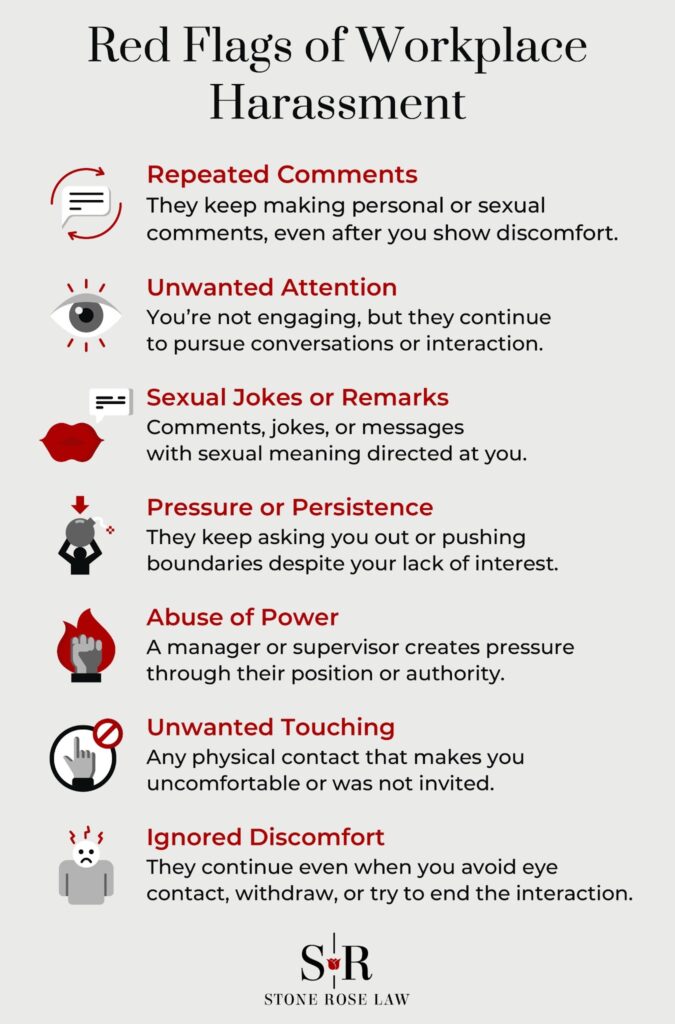
Conduct is more likely to be considered harassment when one person keeps making sexual comments after the other person has shown discomfort. The same is true for repeated requests for dates, repeated comments about a person’s body, sexual jokes directed at a coworker, or unwanted touching.
Other examples include sending sexual messages, asking for sexual favors, making comments that contribute to a hostile work environment, or using job authority to pressure another employee into social or sexual interaction.
Sexual harassment does not require physical contact. Verbal conduct can be enough.
Comments about appearance, repeated sexual remarks, suggestive questions, propositions, or sexual jokes can all become part of a hostile work environment depending on their nature, frequency, and context. Physical conduct, including unwanted touching, can make the situation more serious, but it is not required in every case.
Body language and context can matter when evaluating whether conduct was welcome. Not everyone responds with a direct verbal rejection.
A person may turn away, avoid eye contact, shorten the conversation, stop engaging, or leave when possible. Those signs may indicate discomfort or lack of consent.
Continuing after those signs can increase the risk that the conduct will be viewed as unwelcome.
A casual or friendly office does not eliminate legal boundaries. Employees may joke, chat, and build friendships at work, but that does not make sexual conduct acceptable by default.
Conduct of a sexual nature can still be considered harassment in an informal workplace if it is unwelcome and sufficiently severe or pervasive to create a hostile environment. A relaxed culture is not a defense to repeated unwanted conduct.
Consensual workplace relationships can complicate the analysis, but they do not eliminate it. A prior social or romantic connection does not create ongoing consent to future flirtation or sexual discussion.
Consent can change. Interest can end. Once conduct becomes unwelcome, continuing it can create legal issues if it becomes sufficiently serious, repeated, or coercive, even if the parties previously had a friendly or romantic relationship.
Employees do not always respond directly in the moment. Some fear negative job consequences. Others want to avoid conflict with coworkers or supervisors.
That is one reason a delayed or imperfect response does not automatically mean the conduct was welcome. Silence, nervous laughter, or a delayed complaint does not necessarily show consent.
Employers should have clear reporting procedures, training on appropriate behavior, and policies that distinguish between acceptable workplace conduct and harassment.
Employees should know where to raise concerns and how complaints will be handled. Employers should also reinforce workplace standards regularly rather than treating harassment prevention as a one-time policy document.
If conduct becomes unwelcome, the first step is often to make that clear if it is safe to do so. In some cases, a direct statement that the behavior is unwanted can help create a clear record.
If the conduct continues, employees should report it through internal channels such as human resources, management, or another designated contact. Prompt reporting may matter both for workplace response and for later legal claims.
Documentation is often important in harassment cases. Keep a record of dates, times, locations, what was said or done, who was present, and whether there were messages or emails related to the conduct.
Written documentation can help establish whether the conduct was repeated, whether it was reported, and how the employer responded. In employment matters, details matter.
If other employees saw the conduct or were aware of it, their observations may help support a complaint. Witnesses may also matter when the issue involves a broader offensive environment affecting more than one employee.
Employees who witness harassment should take it seriously. An employer’s response to known conduct can matter when a claim is evaluated.
Sexual harassment claims are evaluated based on the facts. Relevant issues may include the nature of the conduct, how often it occurred, who was involved, whether there was a power imbalance, whether the conduct was severe or pervasive, and whether it affected the terms and conditions of employment.
That is why broad statements about what most people would consider flirting are not enough. The answer depends on the actual behavior and the actual workplace context.
Employees who believe they were sexually harassed should seek legal advice promptly because reporting and filing deadlines may apply. An employment attorney can help evaluate whether the conduct may support a claim, identify which deadlines matter, and determine which steps make sense next.
That may include reviewing internal complaints, messages, witness information, and the employer’s response. It may also include evaluating whether the facts point to a hostile work environment, quid pro quo harassment, or another legal issue.
Whether conduct is flirting or harassment does not depend on the label used. The central questions are whether the conduct was welcome, mutual, and lawful under the circumstances.
Once conduct becomes unwanted, coercive, severe, or pervasive, it may support a sexual harassment claim depending on the facts.
If workplace conduct has crossed the line and you need legal guidance, contact Stone Rose Law at (480) 535-9003 to speak with an employment attorney.