
A late paycheck can create immediate financial problems, especially when bills depend on payday. If an employer is not paying on time, the employee should document the issue, contact payroll or HR in writing, and consider whether a wage claim or legal action may be necessary.
Arizona employees have legal rights when paychecks are late. If the issue is not resolved promptly, an employment attorney can review the late payment, explain the employee’s rights, and determine what remedies may be available.
If you are an employee who has been getting your paychecks late, call us or use our online contact form to speak with a Stone Rose employment law attorney today.
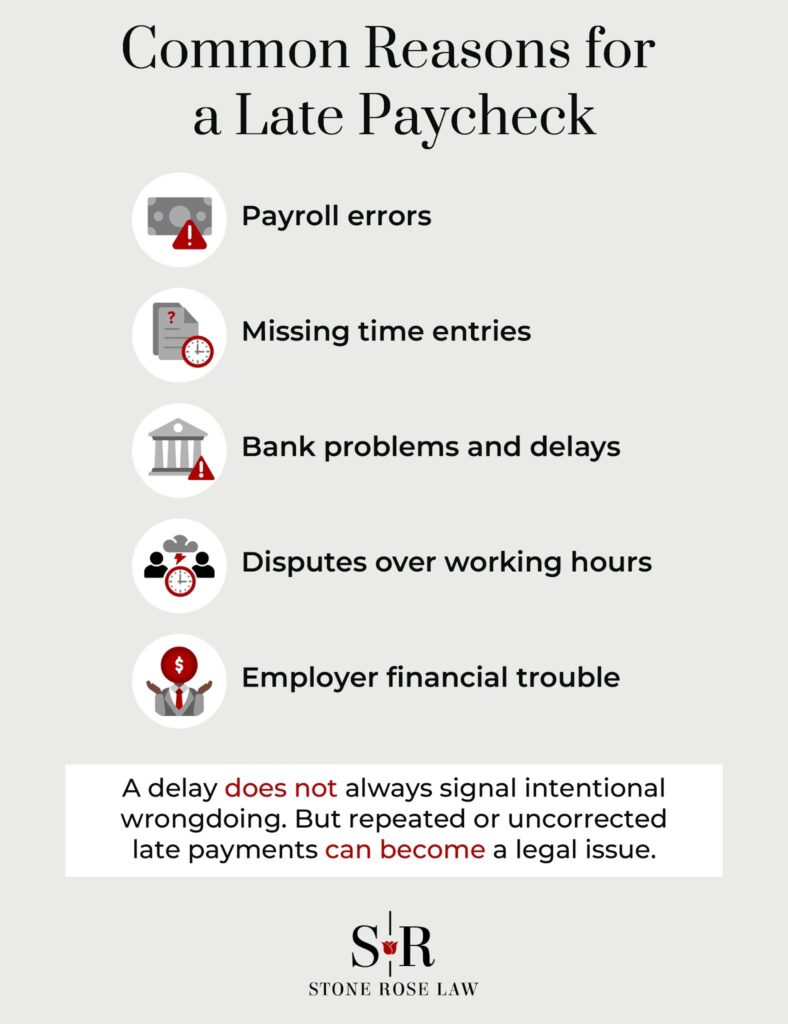
There are several possible reasons a paycheck may be late. A payroll error may cause a late paycheck, a bank delay, a direct deposit issue, missing time entry, an administrative mistake, or an employer cash flow problem.
A delay does not always mean the employer intended to violate wage law. However, an employer who does not pay on time can create a legal issue if wages are not paid by the required payday, if the problem recurs, or if the employer refuses to correct the payment.
Common reasons for a late paycheck include:
If any employee is wondering “why didn’t I get paid today,” the first step is to confirm whether the paycheck is late under the employer’s regular payday, whether payment was timely, and whether a penalty may apply under Arizona law.
If a paycheck is late, the employee should act quickly but carefully. The goal is to create a paper trail, confirm whether the payment is delayed or missing, and preserve evidence before the employer changes its explanation.
Useful steps include:
A calm written message is usually better than a verbal confrontation. It creates documentation and gives the employer a chance to fix the problem.
Employees do not need legal skills to approach their employers, but contact should be direct, specific, and in writing.
A basic email might say:
The employee should keep the email, any payroll response, and proof of whether the paycheck was later issued. This documentation can matter if the employer paying late becomes a recurring problem.
An employee may need to file a wage claim if the employer does not promptly correct a late payment, refuses to pay, disputes wages without a valid basis, or repeatedly misses payday. A wage claim may also be appropriate when final wages are not paid after termination, firing, quitting, or resignation.
Depending on the facts, an employee may file a wage claim with the Industrial Commission of Arizona (the state agency that handles unpaid-wage complaints), contact the Department of Labor’s Wage and Hour Division for federal FLSA issues, or file a lawsuit in state or federal court.
Some smaller wage disputes may also qualify for small claims court, depending on the amount and legal strategy.
Arizona’s wage-claim statute of limitations is short — generally one year from the date the wages were due under A.R.S. § 23-355. Waiting too long can extinguish the right to treble damages, so an employee who suspects a wage violation should act before the deadline runs.
An employment lawyer can explain which path makes sense. A wage claim involving unpaid wages, overtime, retaliation, or repeated late payment may require more than a simple payroll complaint.
Arizona labor laws require employers to designate at least two fixed paydays each month. Those paydays generally cannot be more than 16 days apart.
This means most Arizona employees must be paid on a regular semi-monthly or more frequent schedule. Some employers use bi-weekly pay periods, but they still must comply with Arizona wage payment rules.
A.R.S. 23-351 also regulates how wages must be paid and when wages are considered due. If an employer regularly misses paydays, delays timely payment, or changes paydays without following state law, the employee may have a wage claim and potential penalty issues.
Arizona law includes a narrower exception for certain employers whose principal place of business and centralized payroll system are located outside Arizona, but the regular payday rule still applies in most cases.
Final paycheck rules are different from regular payday rules. In Arizona, when an employee is fired or discharged, the employer must pay final wages within seven working days or by the end of the next regular pay period, whichever is sooner.
When an employee quits or resigns, Arizona law requires the employer to pay all wages due no later than the regular payday for the pay period during which the employee quit.
Final wages may include regular wages, unpaid overtime, commissions, bonuses, paid time off if owed by policy or agreement, or other earned compensation. A late final paycheck can support a wage claim if the employer fails to pay wages due on time.
The FLSA, or Fair Labor Standards Act, is the federal law that governs minimum wage, overtime, and related wage requirements for many employees. The Department of Labor (DOL) and its Wage and Hour Division enforce federal wage and hour rules.
The FLSA does not create Arizona’s regular payday schedule. State law usually controls specific payday timing rules, including semi-monthly paydays and final wage deadlines.
However, a late paycheck may still raise FLSA issues if the delay means an employee was not paid the required minimum wage or overtime pay when due. For example, an employee who worked overtime but did not receive overtime pay may have both federal and Arizona wage issues.
Yes. Employers may face penalties for failing to pay wages on time. Under the Arizona Wage Act, an employee may recover treble damages if an employer fails to pay wages due in violation of the Act.
Treble damages, also called triple damages, may allow recovery of up to three times the unpaid wages. For example, if an employer unlawfully withholds a paycheck, the potential recovery may exceed the original missed payment.
A late paycheck does not automatically entitle a plaintiff to treble damages in every case. The facts matter, including whether wages were due, whether there was a good-faith dispute, how long payment was delayed, and how the employer responded.
Employers generally cannot retaliate against employees for asserting wage rights, filing a wage claim, making a complaint, or asking to be paid wages owed. Retaliation may include firing, demotion, reduced hours, worse shifts, disciplinary action, threats, or other adverse actions.
If an employee asks about a late paycheck and the employer responds by cutting hours, issuing discipline, or threatening termination, the employee should document what happened. Retaliation can give rise to separate legal claims beyond the unpaid wage issue.
An employment attorney can evaluate whether the employee’s conduct was protected and whether the employer’s response violated wage law or retaliation protections.
A one-time payroll mistake may be resolved quickly. The employer should still correct the payment and pay all wages owed.
The issue becomes more serious when the employer fails to correct the late payment, offers shifting explanations, repeatedly delays payment, or tells employees to wait without a clear payment date. Repeated late paychecks can show a larger wage payment problem.
Employees should not ignore repeated late payments. A pattern of late paychecks may affect multiple employees and may support a broader complaint, wage claim, or lawsuit.
Late payments can result in bank fees, overdraft charges, NSF fees, missed bill payments, or other financial harm. Employees should save bank records and any notices showing the charge, date, and connection to the missing paycheck.
Arizona wage law focuses on unpaid wages and available statutory remedies. Related losses may still matter when an attorney evaluates the full claim, settlement value, or employer conduct.
The employee should avoid guessing or inflating losses. Clear records are more useful than estimates.
An employee should consider contacting an employment attorney if the issue is not resolved promptly, the employer misses multiple paydays, final wages are late, or the employer retaliates after the employee asks for payment.
An employment lawyer can review the pay schedule, paycheck records, payroll communications, time records, and Arizona wage law deadlines. A lawyer can also explain whether the employee should file a claim, a complaint, or a lawsuit, or pursue another strategy.
Legal rights can depend on timing, documentation, and the amount owed. A free case review or consultation can help an employee understand what steps to take before the issue worsens.
If an employer is not paying on time, the employee should document the late payment, contact payroll or HR in writing, preserve records, and seek legal guidance if the issue is not resolved promptly.
Late paychecks, unpaid wages, final paycheck delays, and repeated payroll problems can create legal rights under state law and, in some cases, the FLSA. Arizona employees may be able to recover unpaid wages, penalties, treble damages, and other remedies depending on the facts.
An Arizona employment attorney can review the late paycheck, explain the employee’s rights, and determine whether a wage claim, complaint, lawsuit, or settlement may be appropriate. Schedule a free consultation to discuss the late payment and available legal options.
Call us or use our online contact form to speak with a Stone Rose employment law attorney today.