
Per diem employment offers flexibility to both workers and employers, but it also creates confusion about rights, pay, and benefits.
Understanding what a per diem employee is, how this type of work differs from part-time or full-time employment, and what protections exist under Arizona and federal law can help workers avoid exploitation and ensure fair treatment.
If you have questions about your rights as a per diem employee or believe your employer has violated labor laws, contact Stone Rose Law at (480) 535-9003. Our Arizona employment attorneys can review your situation and help you protect your income and job security.
A per diem employee is someone hired on an as-needed basis rather than on a fixed schedule. The term “per diem” comes from Latin and means “per day.”
These workers are paid daily or per shift, without a guarantee of ongoing employment.
Per diem employment is common in industries that rely on flexible staffing, such as:
Per diem work allows employers to fill staffing gaps while giving employees control over when they accept shifts. However, it often limits job stability and access to benefits.
Although per diem and part-time employment may seem similar, they operate under different structures. Part-time employees have regular schedules and ongoing employment relationships, while per diem employees only work when called in.
Key distinctions include:
These differences make per diem employment ideal for workers seeking flexibility, while highlighting the importance of understanding that freedom comes with less stability and fewer guaranteed earnings.
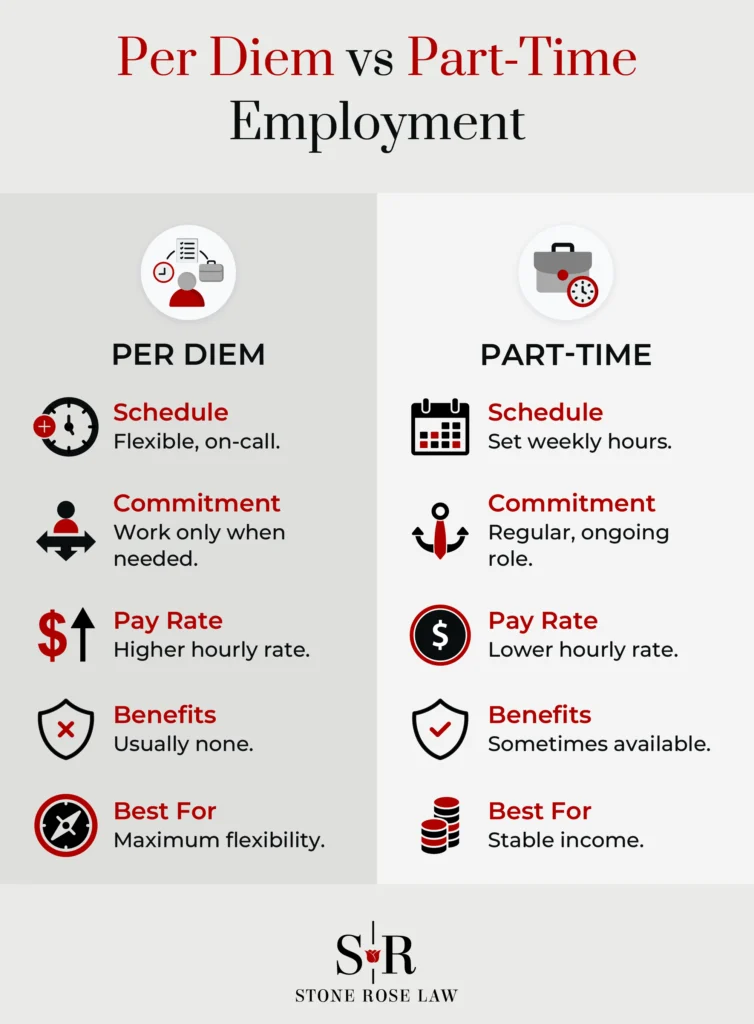
When comparing per diem vs. part-time employment, flexibility is the primary tradeoff. A per diem job offers greater independence but less financial predictability.
Workers seeking consistent income and benefits may prefer part-time or full-time employment, while those who value freedom over stability may find per diem work ideal.
Arizona follows federal wage laws but sets its own minimum wage, which increases annually for inflation.
In 2025, the Arizona minimum wage is $14.70 per hour. Employers must pay per diem employees at least that amount for all hours worked.
Employers who fail to pay the state minimum wage can face penalties, back pay orders, and civil fines. Arizona also prohibits retaliation against employees who report wage theft or file labor complaints.
The federal Fair Labor Standards Act (FLSA) ensures per diem employees receive the same protections as other nonexempt workers. Employers must:
Labeling someone a “per diem employee” does not exempt the employer from FLSA obligations. Job duties and pay structure, not title, determine eligibility for overtime and wage protections.
Per diem employees have the same basic labor rights as other Arizona workers, including:
Employers cannot misclassify per diem workers as independent contractors or “exempt” employees simply to avoid paying overtime or benefits.
Per diem pay is typically calculated on a flat daily or hourly basis. Many industries use scheduling platforms that allow per diem employees to select available shifts. Regardless of pay method, the total amount divided by hours worked must equal or exceed Arizona’s minimum wage.
Employers cannot avoid wage obligations by labeling compensation as a “daily rate” or “per diem pay.” The underlying work hours still determine minimum wage and overtime requirements.
The term “per diem” also appears in federal and state tax codes to describe daily reimbursements for travel expenses. These are not wages but allowances to cover meals, lodging, and incidental expenses while traveling for business.
In employment classification, “per diem” refers to pay structure, not travel reimbursement. It is important to distinguish between:
Understanding this difference helps employers avoid payroll mistakes and ensures employees report the correct income on tax filings.
The General Services Administration (GSA) sets federal per diem rates for travel within the United States. These rates outline daily maximums for lodging, meals, and incidental expenses based on location.
Employers use these rates to reimburse employees without requiring detailed receipts.
However, private businesses can choose their own reimbursement rates. To remain compliant with IRS rules, employers must ensure that per diem allowances are reasonable and supported by documentation.
For per diem reimbursements to be tax-free, they must fall under an accountable plan, which requires employees to:
If an employer lacks an accountable plan or fails to follow these steps, per diem payments become taxable income.
Per diem reimbursements often cover meals and lodging, but not mileage. Separate mileage reimbursement policies must address fuel and vehicle expenses for work-related travel.
Under IRS and federal guidelines, employers can either pay the standard mileage rate or reimburse actual expenses, whichever method is documented.
Employees should keep detailed receipts and expense reports to ensure compliance with federal rules and company policies.
All wages earned through per diem employment are considered taxable income and subject to income tax, Social Security, and Medicare withholdings. Employers must include diem pay on employees’ W-2 forms and withhold appropriate taxes.
In contrast, legitimate per diem reimbursements under an accountable plan are excluded from taxable income. Workers should review company per diem policies carefully to confirm which payments are taxable and which are reimbursements.
Most per diem jobs do not provide benefits such as health insurance, paid time off, or retirement plans. Since these workers are not guaranteed hours, they often fall outside eligibility requirements for company-sponsored programs.
Per diem employees typically do not receive:
However, diem workers may still qualify for unemployment benefits if work hours are reduced involuntarily or if they lose employment through no fault of their own.
Per diem employees are still entitled to overtime under the FLSA. If they work more than 40 hours in a week for a single employer, overtime must be paid at 1.5 times the regular rate.
Employers cannot average hours over multiple weeks or manipulate daily rates to avoid paying overtime.
If an employee performs dual roles, such as working for different employers or staffing agencies, the overtime calculation depends on the total hours with each employer individually.
Proper classification under federal law is critical for per diem employees. If a worker performs duties under the control of an employer, uses company equipment, and follows company policies, that worker is likely an employee, not an independent contractor.
Misclassification can result in:
Accurate classification helps protect both employers and employees by ensuring compliance with wage laws, tax obligations, and benefit eligibility, reducing the risk of costly disputes or government penalties.
Confusion about per diem employment often leads to mistakes.
Common myths include the belief that diem workers are exempt from wage laws or that diem payments are always tax-free. In reality, per diem employees are subject to the same labor laws and tax implications as other workers.
Employers must comply with minimum wage, anti-discrimination, and workplace safety regulations. Diem employees also have the right to report unsafe conditions or wage violations without retaliation.
A per diem job can offer several benefits for individuals seeking flexibility, variety, or extra income. Advantages include:
This flexibility makes diem employment appealing to students, retirees, and professionals looking to maintain control over their schedules.
Despite the benefits, per diem employment carries certain risks and limitations:
For many employees, the tradeoff between independence and stability defines whether per diem work is sustainable long-term.
Employers offering per diem programs must implement clear company policies that comply with federal guidelines and Arizona labor laws. Poorly structured diem policies can create administrative headaches for finance teams, including inaccurate payroll records and inconsistent expense reporting.
To minimize risk, business owners should:
Establishing clear, well-documented per diem policies not only ensures compliance but also reduces disputes, simplifies audits, and promotes transparency between employers and employees.
If you believe your employer has misclassified you, denied proper pay, or mishandled per diem funds, it may be time to seek legal advice. An employment attorney can:
Employers often rely on the complexity of per diem programs to shield themselves from liability. Skilled legal counsel ensures your claim is handled correctly and your rights are fully enforced.
If you have questions about your rights as a per diem employee or believe your employer has violated federal or Arizona labor laws, contact Stone Rose Law at (480) 535-9003. Our employment law attorneys can review your classification, recover unpaid wages, and ensure your employer complies with Fair Labor Standards Act requirements.
We help per diem employees across Arizona understand their rights, protect their income, and achieve fair treatment under both state and federal law.