
Being terminated for false accusations is one of the most confusing and destabilizing ways an employment relationship can end. In Arizona, false accusations, false allegations, and other wrongful claims do not automatically make a termination illegal.
Arizona follows at-will employment, which allows employers to terminate employees for almost any reason, even when the employer’s belief is wrong. However, termination based on false accusations at work can become wrongful termination when it violates employment law, contractual obligations, or public policy.
If you believe you were terminated for false accusations, speak with an employment attorney immediately. Call (480) 535-9003 to discuss potential legal action, filing deadlines, and whether you may be able to seek justice or compensation.
Termination for false accusations typically means an employer fires an accused employee based on false claims, false statements, or unfounded allegations of misconduct. These accusations may involve policy violations, theft, fraud, sexual harassment, sexual misconduct, workplace violence, or other serious allegations that carry professional and personal consequences.
In many cases, the employee is falsely accused without a meaningful review of relevant evidence, without credible witness statements, or without giving the employee a fair opportunity to respond. From a legal perspective, the question is not simply whether the accusations were wrong, but whether the termination violated employment law or contractual protections.
The answer is often yes. Arizona is an at-will employment state, and an at-will employee can be terminated for almost any reason, including reasons based on incorrect information or false allegations, unless a legal exception applies.
False accusations alone are not illegal. An employer can terminate employees based on an honest belief, even if that belief later proves incorrect.
However, false accusations can become legally significant when they are used to hide illegal motives or when the employer acts with reckless disregard for the truth.
At-will employment gives employers broad discretion, but it does not eliminate all employee protections. Employers may not terminate employees in ways that violate state or federal law, breach an employment contract, or violate public policy.
False accusations matter because they often serve as the stated reason for termination, while the real reason is unlawful. Courts and agencies examine whether the employer fires based on lawful reasoning or whether the termination crosses legal boundaries.
A termination may be considered wrongful termination when it falls within a recognized exception to at-will employment.
If an employer fires an employee based on false accusations tied to race, gender, age, disability, or another protected characteristic, the termination may violate employment law. In Arizona, employees fired due to false accusations may have claims for wrongful termination when discrimination is involved.
False accusations are often used as pretext, meaning they provide cover for unlawful discrimination.
False accusations commonly arise after an employee raises concerns, reports discrimination, reports harassment, requests accommodations, or reports illegal activity. When the employer fires the employee shortly afterward, retaliation may be inferred.
Timing, shifting explanations, and weak evidence relied upon by the employer often support retaliation claims.
Arizona recognizes wrongful termination claims when an employer fires an employee in violation of public policy. Examples include firing an employee for refusing to participate in illegal conduct or for reporting wrongdoing.
While Arizona does not mirror the Public Interest Disclosure Act used in other jurisdictions, Arizona law still protects employees who engage in certain whistleblowing activities.
Employees working under an employment contract, a collective bargaining agreement, or a labor union agreement may have termination protections. Even an employee handbook can create enforceable obligations if it promises specific procedures.
If an employer ignores its own policies or bypasses required steps in the company’s disciplinary process, false accusations can support a legal claim.
False accusations occur in many workplace settings, including performance disputes, personal conflicts, and power struggles. They may stem from misunderstandings, workplace disputes, or issues tied to an employee’s personal life.
False accusations may also arise from social media posts, rumors, or statements made by coworkers seeking to avoid discipline themselves. Whether accusations are malicious or mistaken matters when evaluating legal consequences.
The following scenarios show how employees may be wrongfully terminated after false accusations.
Before reviewing the examples, it is important to understand that context and evidence matter.
In all the above scenarios, false accusations are used to justify termination while masking unlawful motives.
Employers are required by law to handle complaints and grievances lawfully, and in certain contexts, such as discrimination or harassment claims, to conduct a reasonable investigation.
A reasonable investigation generally includes the following elements.
Evidence that an employer pre-decided the outcome or conducted a sham investigation can undermine the employer’s stated reason for termination.
Employers should document all steps taken and maintain transparency throughout the process.
If the investigation finds that allegations were knowingly false, employers may choose to discipline the accuser, but they are not legally required to do so. If the evidence suggests the accuser believed the allegations were true, discipline may not be warranted.
Employees must address false accusations carefully to protect their rights and avoid creating new risks.
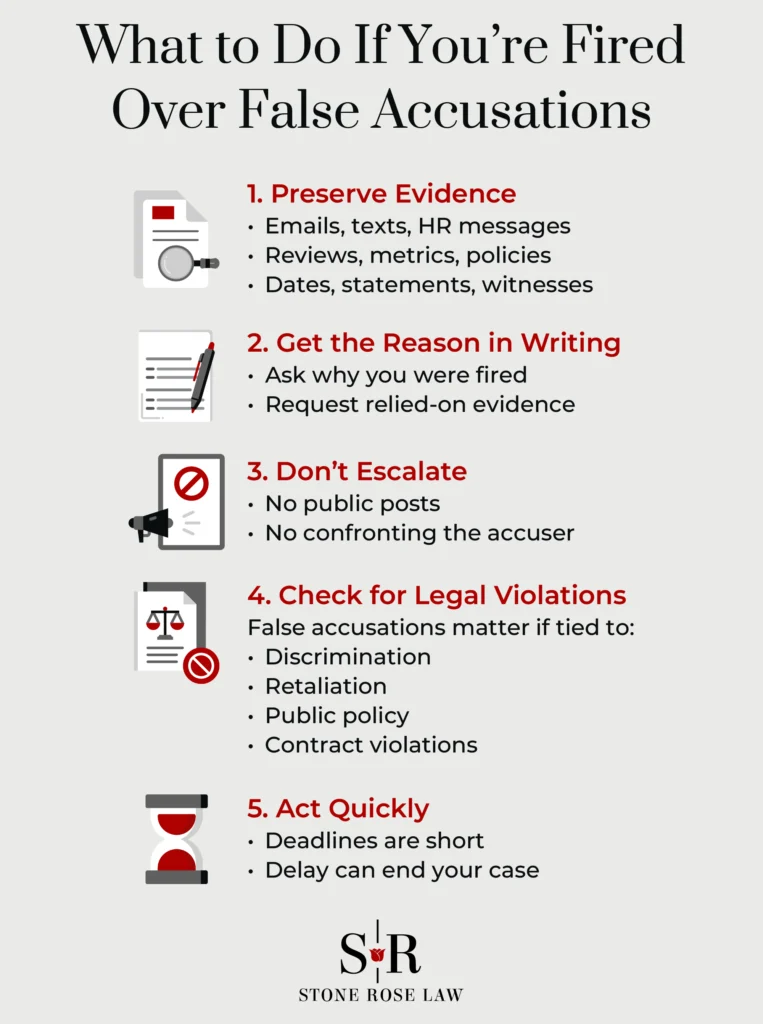
Gathering evidence early is critical, especially before access to systems and records ends. Key materials to preserve include the following:
This evidence often becomes central to any legal claim.
Arizona does not require a termination letter, but requesting a written explanation can lock in the employer’s stated reason. Requesting documentation of the evidence relied upon can later expose inconsistencies.
Avoid direct confrontation with the accuser and avoid public commentary. Emotional responses can undermine credibility and complicate future defamation claims or wrongful termination cases.
Several claims may apply depending on the facts.
You may have a claim for wrongful termination if false accusations were used to hide discrimination, retaliation, or a public policy violation.
Discrimination claims often require filing with the Arizona Civil Rights Division within 180 days, or with the Equal Employment Opportunity Commission within up to 300 days in qualifying cases.
Retaliation claims focus on whether protected activity occurred, whether the employer fired the employee, and whether a connection exists between the two events.
A defamation claim arises when false statements are published to third parties and harm an employee’s personal reputation. Legal defamation requires proof of falsity, publication, and harm. Defamation lawsuits often arise when accusations are shared beyond decision-makers.
Employees may file a civil lawsuit seeking remedies such as lost wages and benefits, and in some cases emotional distress, reputational harm, punitive damages, or reinstatement, depending on the legal theory involved.
Statutes of limitations in Arizona specify that wrongful termination lawsuits often must be filed within one year. Discrimination claims have shorter administrative deadlines. Missing deadlines can permanently bar recovery.
Employers often argue good-faith belief, business judgment, or lack of discriminatory intent. However, employers face legal risks when they act without evidence, ignore relevant parties, or fail to conduct a reasonable investigation.
Consulting with a qualified attorney provides expert legal advice on whether termination may be considered defamation, unfair dismissal, or wrongful termination. An experienced attorney can evaluate evidence, manage deadlines, and advise on strategy.
Saying you were fired for false accusations is the starting point, not the conclusion. The next step is determining whether the employer violated employment law, contract terms, or public policy.
Concrete steps can preserve options and strengthen a case.
While there is no guarantee your claim will be successful, following the appropriate steps can make your claims stronger.
False accusations alone do not always make termination illegal, but they often signal deeper violations when facts are examined closely. If you believe you were wrongfully accused or wrongfully terminated, speak with an experienced employment attorney.
Call (480) 535-9003 to evaluate your situation, discuss potential remedies, and determine whether legal action is available under Arizona law.