
If you were fired for reporting harassment, the termination may be illegal retaliation. Federal and Arizona employment laws protect employees who report workplace harassment, sexual harassment, discrimination, or a hostile work environment in good faith.
If your employer fired you after you made a complaint or participated in an investigation, call Stone Rose Law at (480) 535-9003 or use our online contact form to speak with an employment attorney about your legal rights.
An employer may still terminate an employee after a harassment complaint, but that does not mean the firing is lawful. If the employer fired you because you reported harassment or took part in a complaint process, that may support a retaliation or wrongful termination claim.
This issue often arises after an employee reports sexual harassment, offensive jokes, repeated unwelcome conduct, or other behavior that created an intimidating, hostile, or abusive work environment.
Employees sometimes assume they have no claim because the employer cited poor performance or gave another reason for the termination. However, the key question is whether there is a causal connection between the protected activity and the adverse employment action.
Several federal laws protect employees from retaliation after reporting harassment or discrimination.
Title VII of the Civil Rights Act prohibits employers covered by the statute (employers with 15 or more employees) from retaliating against an employee for reporting discrimination or harassment based on sex, race, color, religion, or national origin.
Title VII also covers retaliation tied to reporting sexual harassment, a hostile work environment, and other workplace discrimination.
Other federal laws may also apply depending on the facts.
For example, the Americans with Disabilities Act protects employees who report disability-based harassment or discrimination. Other federal anti-discrimination laws may also prohibit retaliation involving age discrimination or genetic information, depending on the facts.
Under these federal laws, reporting harassment is a statutorily protected activity. Participating in an internal investigation, supporting another employee’s complaint, filing a charge with the Equal Employment Opportunity Commission, or otherwise opposing unlawful harassment can also qualify as protected activity.
Arizona employees may have protection under both federal and state laws.
The Arizona Civil Rights Act prohibits employment discrimination and retaliation in many of the same areas as federal law. Arizona also has the Arizona Employment Protection Act, or AEPA, which may apply in some wrongful termination situations, including cases involving reports of illegal activity or refusal to violate the law.
For employees in Phoenix and elsewhere in Arizona, both federal and state law may matter.
Depending on the facts, a retaliation case may involve Title VII, the Arizona Civil Rights Act, the AEPA, or multiple legal theories. The correct framework depends on the employer, the nature of the complaint, the timing of the firing, and the reason given for the adverse action.
Protected activity is broader than many employees realize. You do not have to prove the harassment claim before you receive legal protections against retaliation.
A good-faith complaint can still be protected even if the harassment claim is later disputed or not ultimately proven.
Protected activity may include:
That matters because employers sometimes act as though a complaint loses protection unless the employee can prove every allegation, but that is not the standard. A good-faith report can still be protected under federal and state laws.
Retaliation occurs when an employer punishes an employee for engaging in protected activity.
Firing is one example, but it is not the only one. An adverse employment action can take several forms.
Common examples of illegal retaliation include termination, demotion, pay cuts, reduced hours, denial of promotion, unwarranted discipline, negative performance reviews that do not match the employee’s prior history, increased scrutiny, punitive schedule changes, or reassignment to a worse position.
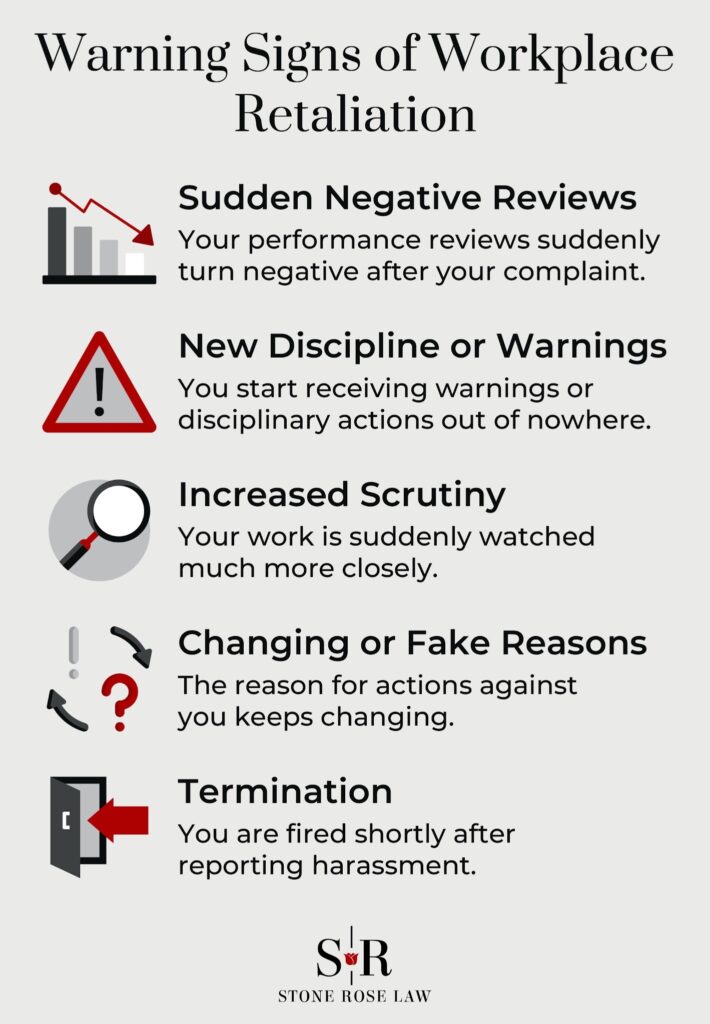
In a retaliation claim, the employee usually must show three basic points: protected activity, an adverse action, and a causal connection between the two.
Timing can matter, but that alone is not always enough. Emails, shifting explanations, inconsistent discipline, witness statements, and detailed records often matter as well.
If you were fired for reporting sexual harassment or complaining about a hostile work environment, the firing may support a retaliation claim and, in some cases, a wrongful termination claim.
Title VII prohibits an employer from punishing an employee for opposing unlawful harassment or participating in a complaint process.
A hostile work environment can involve unwelcome conduct based on a protected characteristic, including conduct of a sexual nature that is severe or pervasive enough to affect the terms and conditions of employment. If an employee reports that type of behavior and the employer later fires the employee, the timing and surrounding facts may point to illegal retaliation.
That can be true even if the underlying complaint involved offensive jokes, repeated comments, sexual remarks, or other conduct the employer tried to dismiss as minor. The employer cannot avoid liability by punishing the employee for speaking up.
Employers rarely admit they fired someone for reporting harassment. More often, they point to poor performance, attitude problems, restructuring, attendance issues, or another stated reason.
That does not make the reason legitimate.
In many retaliation claims, the dispute centers on whether the employer’s stated reason is genuine or a pretext for retaliation. A sudden negative review after a clean record, discipline that began only after the complaint, different treatment from similarly situated employees, or inconsistent explanations can all support the argument that the employer retaliated.
Act promptly. Delays can create evidentiary problems and deadline issues. If you believe your employer fired you for reporting harassment, take steps to preserve information and protect your position.
Start by gathering evidence. Save emails, texts, written complaints, performance reviews, disciplinary notices, termination paperwork, and any other records connected to the report or the firing.
Create a timeline with dates, names, and relevant details. Identify witnesses who saw the harassment, knew about the complaint, or observed how the employer responded.
You should also review the employer’s anti-harassment and complaint policies if you still have access to them. Those policies may matter if the employer failed to follow its own procedures.
In many cases, filing a charge with the Equal Employment Opportunity Commission or the Arizona Civil Rights Division is required before filing suit. These agencies investigate claims involving discrimination, harassment, and retaliation.
Arizona is a deferral state, which affects filing deadlines.
A charge filed with the Arizona Civil Rights Division is generally due within 180 days of the retaliatory act. A charge with the Equal Employment Opportunity Commission is often due within 300 days in Arizona because the state has its own anti-discrimination agency, although the deadline may vary depending on the claim, the employer, and the filing arrangement.
These deadlines matter. Missing one can damage or eliminate a claim.
The correct filing strategy can also depend on the facts and the statutes involved, so this is an area where legal advice is important.
If you were wrongfully terminated for reporting harassment, available remedies may include back pay, lost wages, lost benefits, reinstatement, front pay in some cases, attorney fees, and court costs. Depending on the facts and the applicable law, other damages may be available, including compensation for emotional distress and, in some cases, punitive damages.
Not every case results in recovery in every category. The outcome depends on the statute, the evidence, the employer’s conduct, and the losses the employee can prove.
Even so, retaliation laws exist to hold employers accountable when they punish employees for protected activity.
Retaliation claims often turn on timing, documentation, and legal framing. An experienced employment attorney can evaluate whether the report qualifies as protected activity, whether the employer’s conduct rises to the level of an adverse employment action, what deadlines apply, and what evidence matters most.
Employers often frame retaliation cases as performance or conduct disputes. An experienced employment lawyer can review the facts, identify the strongest legal theory, and help you decide whether to file a complaint, pursue legal action, or take other steps to protect your rights.
Employees do not lose their legal rights by reporting harassment. Federal and Arizona employment laws protect workers who, in good faith, report sexual harassment, workplace harassment, discrimination, or a hostile work environment.
If an employer fired you, demoted you, or took other adverse action after you made a complaint, the conduct may qualify as illegal retaliation.
If you believe you were fired for reporting harassment, call Stone Rose Law at (480) 535-9003 or use our online contact form to speak with an employment attorney about your situation.