
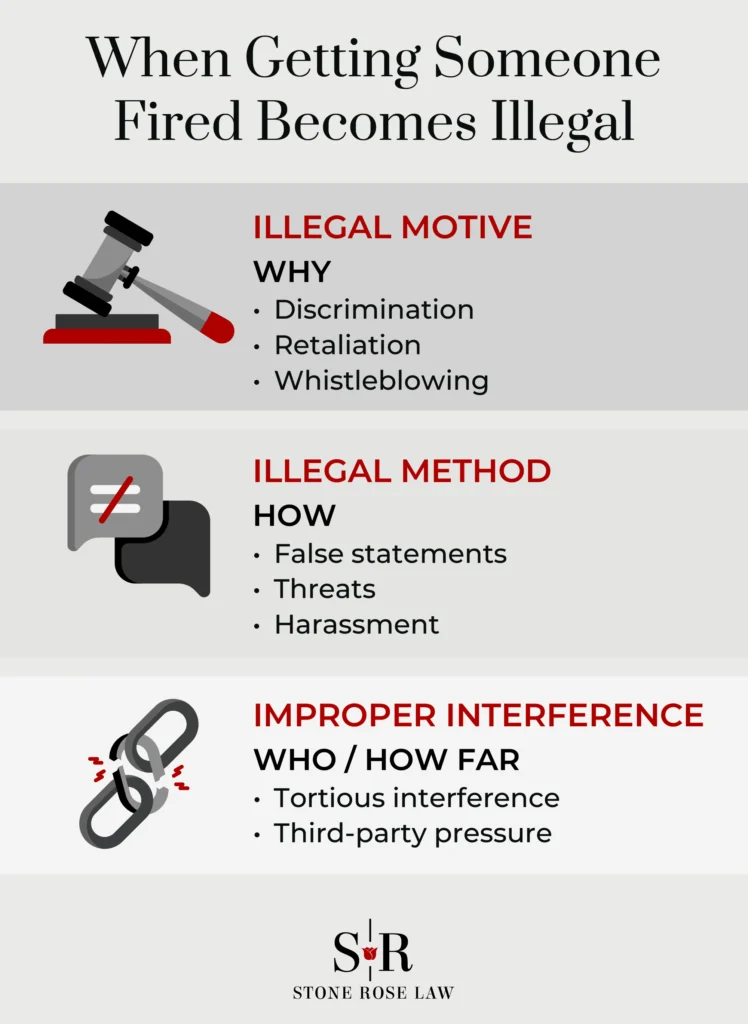
In Arizona, conspiring to get someone fired is sometimes illegal, but not automatically. The conduct becomes unlawful when the plan relies on an illegal reason (discrimination or retaliation), an illegal method (defamation, threats, harassment), or improper interference with an employment relationship (tortious interference).
In an at-will workplace, someone can push for termination and still stay within the law, but coordinated conduct can create civil liability and, in narrow scenarios, criminal exposure.
For help evaluating job-loss risk, evidence, and potential claims or defenses, call Stone Rose Law at (480) 535-9003 to speak with an employment attorney.
Arizona generally follows at-will employment, which allows an employer to end the employment relationship at nearly any time for almost any reason. That baseline explains why many “get them fired” scenarios feel unfair yet remain lawful.
The legal analysis changes when a termination involves protected rights, protected classes, or unlawful conduct aimed at causing job loss.
People use “conspire” to describe coordination, group pressure, or a campaign to remove someone. Employment law focuses less on the label and more on the underlying conduct.
The key questions stay consistent across state laws and federal law: what was said or done, what motive drove it, and whether the conduct caused termination.
A workplace effort to remove an employee can remain lawful when it fits inside legitimate management or business activity and avoids illegal motives or methods. Common lawful scenarios include the following examples.
If the information is truthful and the motive is not discriminatory or retaliatory, legal grounds for a lawsuit often do not exist, even when job loss results.
A coordinated effort becomes unlawful when the real reason for termination is a protected characteristic. Federal law and Arizona employment discrimination rules generally prohibit disparate treatment based on characteristics such as race, national origin, sex, religion, age, disability, and related protected categories, including sexual orientation and gender identity in many contexts.
“Conspiring” to force termination for a discriminatory reason can support a wrongful termination claim and other legal claims, depending on who participated and how.
Retaliation is one of the most common ways a “conspiracy” becomes actionable. Protected activity can include reporting harassment, complaining about discrimination, participating in investigations, filing a workers’ compensation claim, requesting disability accommodations, or refusing to engage in illegal activity.
A coordinated plan to remove an employee because of protected activity can support wrongful termination claims against the employer and related claims tied to the campaign.
Harassing behavior can be unlawful when it is severe or pervasive enough that enduring the offensive conduct becomes a condition of employment. Coordinated workplace harassment aimed at forcing someone out can overlap with discrimination law, retaliation law, and tort claims.
Petty slights and isolated incidents typically do not rise to illegal harassment, but escalation patterns matter.
Conspiring to get someone fired by making false statements to an employer can create liability. A defamation claim generally requires a false statement of fact, publication to someone else, and harm.
In the employment setting, a false allegation of theft, fraud, violence, or serious misconduct often carries the highest risk because it predictably leads to termination and reputational harm.
Workplace communications sometimes carry legal privilege, meaning liability depends on context, purpose, and whether the statement was made in good faith. The details matter, including who received the statement and whether the speaker had a business reason for the communication.
Arizona recognizes claims for tortious interference when someone intentionally and improperly interferes with another’s employment relationship and causes job loss. This claim comes up in scenarios involving a competitor, a vindictive third party, an ex-partner contacting an employer, or a coworker acting outside legitimate business interests.
Tortious interference can apply even when employment is at-will, because the law still protects the relationship from improper disruption.
Threats, blackmail, stalking, or coercive conduct used to force termination can create civil liability and may cross into criminal law. A conspiracy charge under Arizona law typically requires an agreement to commit an illegal act and an overt step toward it.
Most workplace plots do not qualify, but the risk increases when conduct involves crimes as the tool used to achieve job loss.
A third party can contact an employer and trigger termination, especially in at-will employment. That fact alone does not create legal claims.
Liability depends on what was communicated and why. If the call included knowingly false statements presented as facts, threats, or a discriminatory or retaliatory motive, legal grounds for a claim become more plausible.
A lawsuit becomes realistic when evidence supports one or more of these theories.
A claim usually requires proof that the conduct caused job loss, not merely that bad behavior occurred.
Start with preservation and structure. Timing and documentation often determine whether a case exists and whether it is provable.
Take steps that build a reliable record without escalating risk.
This record helps show causation, motive, and pattern, and it also helps rebut false narratives.
The first priority is evidence preservation and controlled communications. Avoid contacting the plaintiff, witnesses, or the employer about the dispute outside formal channels.
Focus on factual documentation and defensible explanations.
Common defenses include truth, lack of malice, opinion, privilege, lack of causation, and legitimate business interest, depending on the claims asserted.
Employment contracts and written policies can convert an at-will arrangement into a situation where the employer must follow agreed procedures. If termination breaches a written contract, a notice period, or handbook promises that function as an implied contract, the employer faces breach exposure.
A coordinated effort to push termination in violation of required procedures can strengthen the employee’s legal rights, even when the underlying employment relationship looks at-will on paper.
These cases often turn on specific categories of proof. The goal is to show motive, method, and causation with documentation rather than inference.
Evidence gaps often explain why many “conspiracy” situations never become viable legal claims.
At-will employment allows termination for reasons that feel irrational, harsh, or unfair. The law does not require an employer to be correct, kind, or consistent.
Legal rights usually arise only when conduct violates anti-discrimination laws, public policy, contract obligations, or tort rules like defamation or tortious interference.
Conspiring to get someone fired can be lawful workplace behavior or it can create real liability, depending on motive, method, and proof. A fast legal review can identify whether the situation fits wrongful termination, employment discrimination, defamation claim exposure, or tortious interference, and what defenses apply if accusations are aimed in the other direction.
To discuss whether conduct related to job loss creates legal claims or legal risk under Arizona or federal law, call Stone Rose Law at (480) 535-9003 to speak with an employment attorney.