
Off-duty conduct refers to an employee’s actions outside of work hours and away from the employer’s premises.
While many employees assume what they do on their own time is entirely private, that is not always the case. Off-duty conduct can raise serious concerns for both employees and employers, particularly when personal activities intersect with workplace expectations.
In certain situations, off-duty conduct can legally affect employment, especially when it impacts job performance, workplace safety, or an employer’s business interests.
Understanding how off-duty conduct and employee rights intersect is critical in at-will employment states like Arizona.
If concerns about off-duty conduct have affected your job or put your employment at risk, speak with an employment law attorney at (480) 535-9003 to discuss your rights and options.
Off-duty conduct can include both lawful and unlawful activities that occur outside working hours. On-duty conduct, by contrast, occurs during work hours or while an employee is performing tasks on behalf of the employer.
Examples of off-duty conduct include political activities, social media posts, outside employment, criminal behavior, or public conduct that draws attention to the employer.
The key issue is not simply where or when the conduct occurred, but whether it creates a connection to the workplace.
Off-duty conduct may be treated as work-related when it affects job performance, disrupts workplace relationships, harms the employer’s reputation, undermines customer trust, creates safety concerns, or renders the employee unsuitable for their role.
Many employees assume they can engage in lawful off-duty conduct without discipline, particularly when the conduct does not interfere with job duties or the employer’s business. Whether that assumption is legally protected depends largely on state law and the specific circumstances involved.
Some states prohibit employers from taking adverse action based solely on lawful activities that occur off the clock, while others provide little or no statutory protection for such conduct.
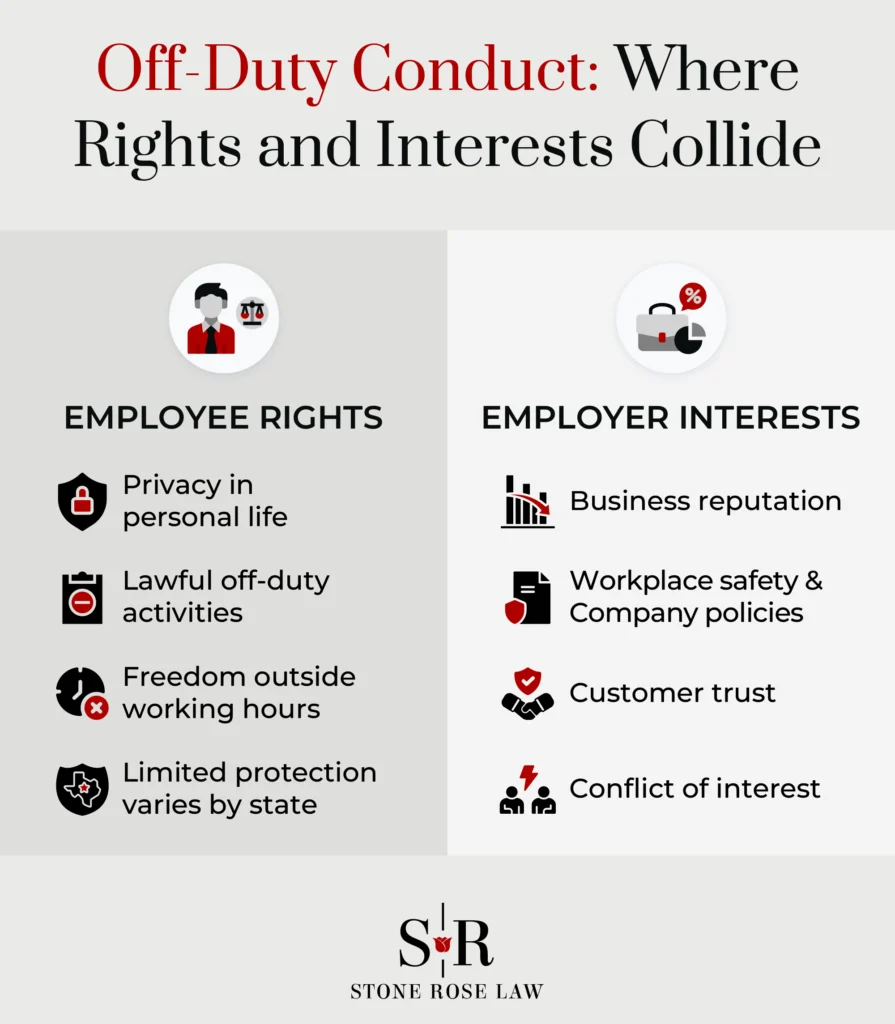
Employees also have limited privacy protections related to their personal lives. Employers generally have greater legal risk when disciplining employees for purely private conduct that has no workplace impact.
However, privacy protections weaken when conduct becomes public, particularly through social media or interactions with the general public. Public social media posts, even if made off-duty, may be treated differently from private communications shared only with close contacts.
State law plays a major role in determining how off-duty conduct is treated.
Some states provide broad protections for lawful off-duty activities, while others allow employers greater discretion. California has statutes that provide protection against adverse action based on certain lawful off-duty conduct, subject to exceptions.
Arizona does not offer the same level of statutory protection, which means outcomes often depend on whether the employer’s action violates public policy or anti-discrimination laws. Because off-duty conduct laws vary widely, employees should not assume that protections in one state apply in another.
While employment law sets limits on how employers can respond to employee conduct outside of work, private employers generally have broad authority to discipline or terminate employees, particularly in at-will employment states.
At-will employment allows employers to fire employees for almost any reason, including off-duty conduct, as long as the reason is not illegal.
Employers may justify termination by pointing to reputational harm, conflicts of interest, or violations of company policy. However, employer discretion is not unlimited and must still comply with employment law restrictions.
Although Arizona is an at-will employment state, employers cannot use off-duty conduct as a pretext for unlawful discrimination or retaliation. Laws protecting employee rights come from a mix of federal statutes, state laws, and public policy principles.
Arizona law, through the Arizona Employment Protection Act, limits wrongful termination claims primarily to violations of specific statutes or written employment contracts, such as firing an employee for performing jury service.
Off-duty conduct is more likely to lead to discipline when it adversely affects the workplace.
Conduct may be considered connected with work if it undermines trust, creates safety risks, damages the employer’s public image, or interferes with job performance. Employers often focus on whether the conduct impacts other employees, customers, or the employer’s business operations.
Political activities often raise concerns about off-duty conduct. Because employees may engage in political activity on their own time, some states provide limited protections for political affiliation or lawful political activity, but the scope of these protections varies significantly.
The First Amendment generally does not apply to private employers, meaning free speech protections are limited in the private sector. Employers may still take action if political expression harms business interests or violates company policies.
Social media posts are one of the most common sources of off-duty conduct disputes. Employers may discipline employees for public social media content that damages the employer’s reputation, reveals confidential information, or constitutes harassment.
Employees who post publicly may waive certain privacy expectations, especially when content is visible to customers, coworkers, or the general public.
Employers may discipline employees for off-duty conduct involving illegal activities.
Most states do not require a criminal conviction before an employer may take action, although some states restrict how arrest records may be used. Moreover, employers can often act based on credible evidence of unlawful conduct or policy violations, particularly when the conduct relates to job duties, such as getting a DUI while employed in a driving position.
Criminal behavior that poses a risk to coworkers or the public is more likely to justify disciplinary action.
Clear, consistently enforced policies can reduce legal risk when employers address off-duty conduct. Policies should explain when off-duty behavior may result in disciplinary action and should be applied uniformly to avoid discrimination claims.
Investigations into off-duty misconduct should be structured, confidential, and based on objective evidence rather than assumptions.
Employees should understand that off-duty conduct can carry legal and professional risks. Even lawful conduct may lead to consequences if it conflicts with written agreements, confidentiality obligations, or business interests.
When questions arise, documenting interactions and seeking legal advice can help employees protect their rights.
Off-duty conduct and employee rights involve a delicate balance between personal life and professional responsibilities. Employers often have broad authority, but that authority is not unlimited.
If you were disciplined or terminated for off-duty conduct, an employment law attorney can assess whether the decision violated public policy, employment law, or protected rights. For guidance tailored to your situation, contact one of our experienced employment law attorneys at (480) 535-9003.