The U.S. Department of Veterans Affairs (the VA) recognizes Crohn’s disease as a compensable disability. Veterans who qualify for Crohn’s disease VA compensation can receive a disability rating of 10%, 30%, 60%, or 100%.
Stone Rose Law represents U.S. military veterans who have initial or supplemental disability claims and appeals of initial claims that the VA has denied.
If you wish to apply for a Crohn’s disease VA rating, please contact Stone Rose Law at (480) 498-8998 to speak with a VA benefits specialist and schedule a disability benefits consultation.
Your Crohn’s disease VA rating depends on the frequency, severity, and duration of your Crohn’s symptoms and how these symptoms affect your work, life, and social functioning. A medical diagnosis of Crohn’s disease must be confirmed by endoscopy or radiologic studies.
Disability ratings from least to most severe are as follows.
At this level, you have minimal to mild symptomatic inflammatory bowel disease characterized by recurrent abdominal pain with three or fewer daily episodes of diarrhea and no signs of systemic toxicity. You can manage symptoms with oral or topical agents other than immunosuppressants or other biologic agents.
This rating involves mild to moderate inflammatory bowel disease, characterized by recurrent abdominal pain with three or fewer daily episodes of diarrhea and minimal signs of toxicity such as fever, tachycardia, or anemia. You can manage symptoms with oral and topical agents other than immunosuppressants or other biologic agents.
Symptoms for this rating are moderate inflammatory bowel disease with recurrent abdominal pain, four to five daily episodes of diarrhea, and intermittent signs of toxicity like fever, tachycardia, or anemia. You can manage symptoms on an outpatient basis with immunosuppressants or other biologic agents.
Here, your symptoms are those of severe inflammatory bowel disease that is unresponsive to treatment. You require hospitalization at least once per year. You either cannot work or experience recurrent abdominal pain with at least two of:
Crohn’s disease is one of two forms of IBD, the other being ulcerative colitis. Crohn’s can affect any part of the full length of your gastrointestinal tract, but it most often affects the end of your small intestine and the beginning of the colon. Complications of Crohn’s can include narrowing of the intestine, fistulas, abscesses, and malnutrition.
Multiple factors can contribute to the onset of Crohn’s disease. These include genetic predisposition, abnormal immune responses, and environmental factors. Persistent or recurrent symptoms of Crohn’s can include:
Crohn’s disease is a lifelong condition with no cure. Treatment consists of managing symptoms to improve quality of life, and usually includes a combination of medications like anti-inflammatory drugs, immune system suppressors, and antibiotics to reduce digestive tract inflammation and control symptoms. In severe cases, surgery may be needed to remove damaged portions of the intestine or treat complications.
You can make a claim for service-connected Crohn’s disease VA benefits as a direct or secondary condition.
To establish a direct service connection for Crohn’s, you must provide the following information:
An aggravation claim may be possible when an existing potential primary disability condition worsens because of your military service.
Although Crohn’s disease is generally a disqualifying condition for U.S. military enlistment, in rare cases, a medical waiver may be granted if the disease has been in long-term remission, requires no medication, and has caused no complications.
In such an instance, if military service worsens such a pre-existing Crohn’s condition, then this could be grounds to claim Crohn’s disability based on aggravation of a pre-existing condition.
In some cases, Crohn’s disease is not caused by your military service but instead is caused by another service-connected disability.
Qualifying for Crohn’s disease as a secondary VA disability condition requires the following:
The VA accepts secondary claims if there is strong, clinical documentation explaining the relationship between both conditions. The more well-documented, specific, and consistent your medical history and other supporting documentary evidence are, the stronger your secondary disability case becomes.
Many veterans develop depression, anxiety, or sleep disorders as a result of chronic pain, dietary restrictions, or the fear of sudden flare-ups. When mental health symptoms are directly tied to a service-connected physical illness like Crohn’s, veterans may be able to pursue secondary claims for conditions such as major depressive disorder, generalized anxiety, or insomnia.
PTSD is another mental health condition that affects many veterans. Stress-related hormone imbalances and immune system disruptions related to PTSD can compromise your gut function over time, creating an environment where diseases like Crohn’s may arise.
Psoriasis is a chronic autoimmune condition that causes skin cells to build up quickly. This leads to red, scaly patches that can itch or hurt. Crohn’s disease and psoriasis share immune system-related origins.
Veterans who have psoriasis are more likely to develop Crohn’s disease later in life. Veterans who served in areas where they were exposed to toxic chemicals like those found in fuel, solvents, or burn pits may develop psoriasis as a result.
In addition to being a possible secondary disability claim, if you have a disability rating for Crohn’s disease, this can be the underlying disability that can lead to a secondary disability claim for other conditions.
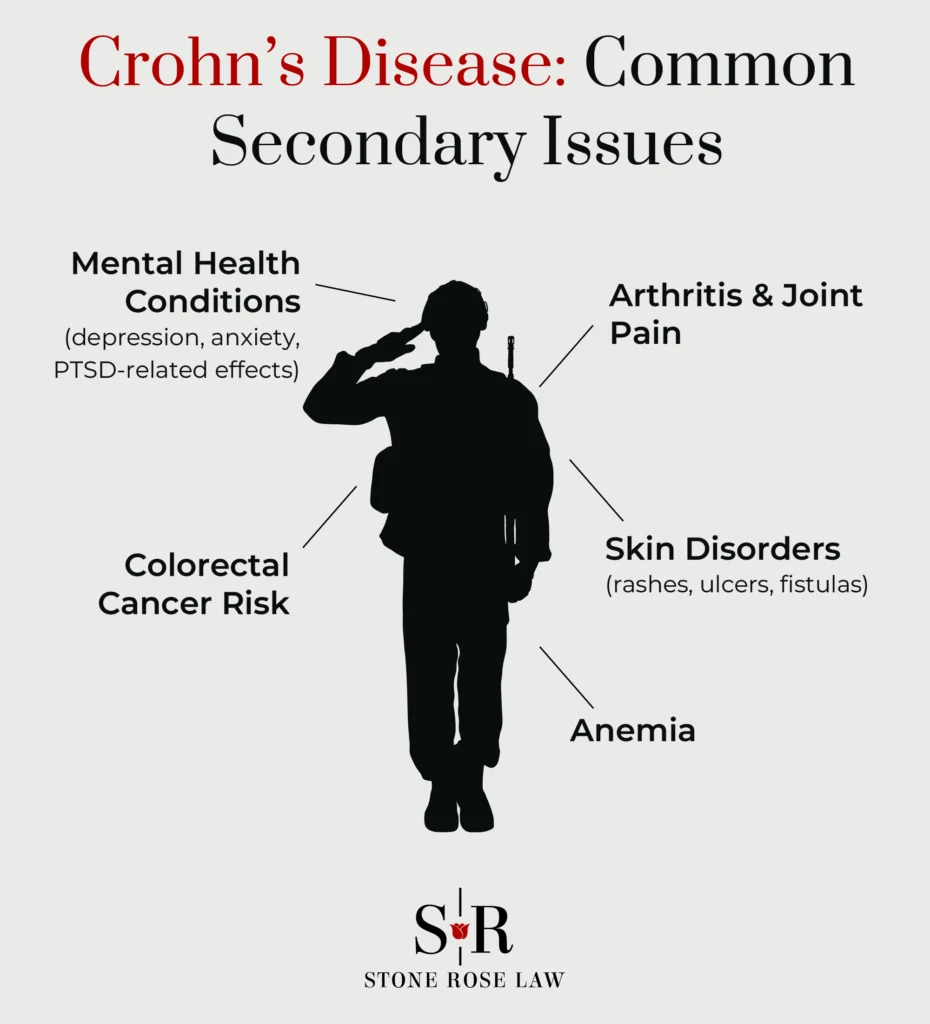
Crohn’s disease can contribute to joint pain or swelling that includes inflammation in the spine and large joints. If joint pain begins after a Crohn’s diagnosis, or becomes more intense during flare-ups, it may be part of the Crohn’s disease process and could support an additional claim.
Some people with Crohn’s develop painful rashes, ulcers, or lesions, often around sensitive areas of the body. One of the most severe examples is the development of perianal fistulas. These are infected tunnels that form between the intestines and the skin near the anus. About one in three people with Crohn’s will experience this complication.
Crohn’s disease increases the risk of colorectal cancer, especially for people who have lived with the condition for many years. If colorectal cancer is diagnosed and linked to chronic inflammation caused by Crohn’s, the VA may consider it a secondary condition.
Many veterans with Crohn’s disease also develop anemia, a condition in which your body does not produce enough healthy red blood cells to carry oxygen effectively. This is usually due to chronic blood loss from the intestinal tract. If you are diagnosed with anemia related to Crohn’s disease, this may qualify you for a separate rating or be included as part of your total disability picture.
Even if your Crohn’s disease does not rise to the level of a 100% disability rating, you may still be eligible for total disability benefit compensation based on Total Disability based on Individual Unemployability, or TDIU. This benefit provides a veteran with the same compensation as a 100 percent rating when the veteran’s disability prevents that person from holding substantially gainful employment.
To qualify for schedular TDIU, in addition to being unable to hold substantially gainful employment, you must also have a single service-connected disability of at least 60% or a combined disability rating of at least 70%, with one disability rating of at least 40 percent.
In some cases, a veteran who cannot qualify for schedular TDIU may still qualify for extra-schedular TDIU. For this form of TDIU, the VA considers how your unique symptoms affect your employability even if the percentage doesn’t meet the standard threshold.
The VA does not always approve initial VA disability benefits claims. Sometimes service-connected conditions are denied due to a missing nexus statement, a lack of documented symptom severity, or failure to link the condition to an existing service-connected issue.
On other occasions, the VA can under-rate an approved claim because secondary complications like arthritis, anemia, or mental health symptoms were never considered.
Fortunately, if this happens to you, then you have options to have the VA reconsider its initial decision. You can file a supplemental claim with new relevant evidence, request a higher-level review of your application, or make a request to the VA Board of Appeals for a formal hearing.
Our Stone Rose Law veterans lawyers represent veterans with VA benefits claims, including claims for IBD-related conditions like Crohn’s disease.
If the VA has denied your initial benefits claim or has assigned you a lower VA disability rating than you believe you deserve, we can help you file a supplemental claim or represent you on appeal.
If you are facing any of these proceedings or issues with your Crohn’s disease claim, then do not hesitate to reach out for a free consultation to learn how one of our qualified VA lawyers at Stone Rose Law can fight for you.
Call us at (480) 498-8998 or use our online contact form to set up a confidential, free consultation with a veterans law attorney.