A spinal fusion is a condition that the U.S. Department of Veterans Affairs (the VA) recognizes as a compensable condition. Your spinal fusion VA rating can range from 10% to 100%, with various ratings in between.
Stone Rose Law represents military veterans in all stages of the benefits claim process, including initial claims, supplemental claims, benefits readjustments, and appeals of denied claims.
If you would like to receive a VA rating for spinal fusion, please call Stone Rose Law at (480) 498-8998 or contact us online to speak with a skilled veterans benefits attorney in a free consultation.
The VA rates spinal fusion conditions under 38 CFR § 4.71a.
If spinal fusion qualifies as a service-connected disability, then the VA can assign you a spinal fusion disability rating of 10%, 20%, 30%, 40%, 50% or 100%, depending on how the condition affects you.
Key to the determination of a spinal fusion disability claim is the concept of “ankylosis.” Ankylosis can be favorable or unfavorable in nature:
Both favorable and unfavorable ankylosis from spinal fusion can be considered based mainly on the range of motion of your spine, including forward flexion and your combined range of motion. In addition to range of motion, the VA considers functional loss due to pain, flare-ups, and the impact on your daily life and work.
Functional loss is evidenced by pain during motion.
For example, you may be able to bend forward 85 degrees, but start experiencing pain at 55 degrees.
In this case, you should receive a disability rating consistent with your range of motion measurements and the functional limitations caused by your back pain.
If they exist, spinal fusion-related flare-ups can qualify you for a higher disability rating. For example, if your spinal fusion condition qualifies you for a 10 percent disability rating, but when you experience a flare-up, your symptoms worsen in a way that could qualify you for a 20% disability rating, then the VA should assign you the 20% rating.
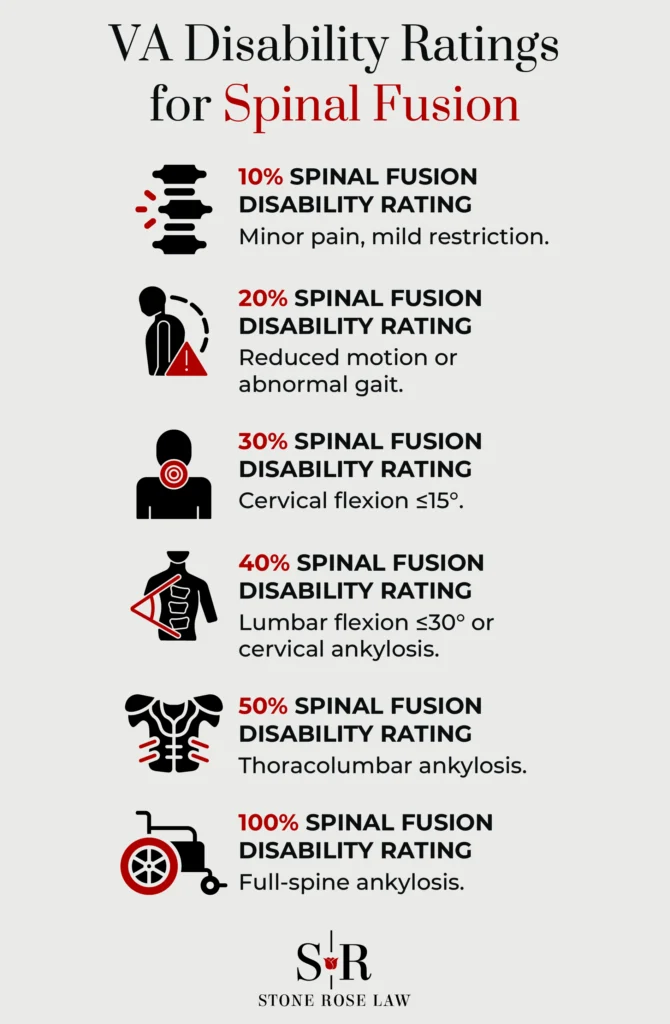
The VA assigns a 10% disability rating for any of:
The VA assigns a 20% rating for any of:
The VA assigns a 30% rating for forward flexion of your cervical spine of 15 degrees or less, or favorable ankylosis of your entire cervical spine.
The VA assigns a 40% disability rating for unfavorable ankylosis of your entire cervical spine, or forward flexion of your thoracolumbar spine of 30 degrees or less, or favorable ankylosis of your entire thoracolumbar spine.
The VA assigns a 50% rating to unfavorable ankylosis of your entire thoracolumbar spine.
The VA assigns a 100% rating for unfavorable ankylosis of your entire spine.
In some circumstances, even if you do not qualify for a 100% disability rating for surgical spinal fusion, you may still be able to receive a total disability rating based on TDIU.
Schedular TDIU can apply if your disability keeps you from substantially gainful employment and your disability rating is based on either of:
For TDIU based on spinal fusion, the VA has no rating between 50% and 100% so a spinal fusion alone cannot qualify you for TDIU. But if you have a spinal fusion disability rating as part of a combined disability rating of 70% or more, and either your spinal fusion disability rating or another disability rating that is part of your combined disability rating is at least 40%, then you may receive TDIU with a spinal fusion disability.
To receive a VA disability rating for a spinal fusion condition, you must demonstrate that your spinal fusion surgery was necessary because of an event that happened during your time in service. This event may have caused or aggravated your spinal fusion.
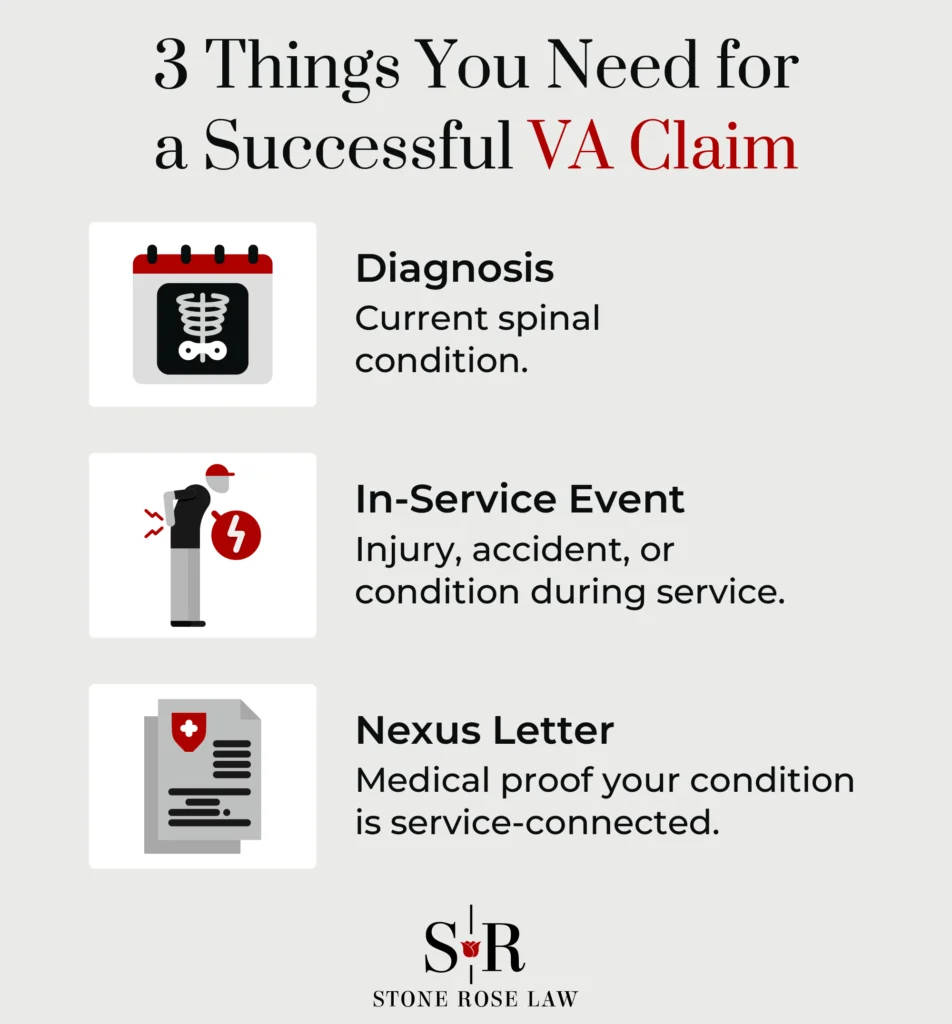
The VA generally requires you to establish all of the following three elements to prove a direct service connection for a spinal fusion condition:
You support your claim with documentary evidence, including medical records and written statements by others who have observed the effects that your spinal fusion condition has on your work and daily life activities. The most important element is the medical nexus. Often this takes the form of a nexus letter, in which your diagnosing and treating doctor or a VA healthcare provider states that your spinal fusion is at least as likely as not due to your time in service.
Sometimes, a spinal fusion disability can be the source of another disability for which you can receive a VA rating. For example, service-connected spinal fusion can contribute to long-term nerve damage as a secondary disabling condition.
At Stone Rose Law, our attorneys have extensive experience and skill in helping veterans qualify for the VA disability benefits they are entitled to, including benefits related to a service-connected spinal fusion disability.
Because spinal fusion can occur naturally as well as from surgery, you may not realize that your spinal fusion is related to your military service. A VA-accredited attorney, like one you will have if you work with Stone Rose Law, can help you gather the necessary medical documentation to prove your spinal fusion condition is service-connected.
If you have already applied for spinal fusion disability benefits and the VA has denied your initial claim, we can help you file a supplemental claim with new and relevant evidence, request a higher-level review, or even make a formal appeal to the VA.
If you have an existing spinal fusion rating for which you are receiving VA disability compensation, but your condition has worsened since the rating was established, we can help you apply for a rating adjustment.
No matter where you are in the process of a spinal fusion VA disability claim, Stone Rose Law can assist. Contact us at (480) 498-8998 or use our contact form to schedule a free consultation.