Our experienced VA disability attorneys at Stone Rose Law can help Delaware veterans by providing free assistance in preparing, filing, and tracking your initial or supplemental VA benefits claim. We can also help you determine which Delaware disabled veterans benefits you can claim in addition to any VA disability benefits you receive.
Call Stone Rose Law today at (480) 498-8998 to discuss your Delaware VA benefits claims.
Veterans who have service-related injuries that they sustained or made worse during their service are eligible for healthcare and monthly compensation benefits as part of the VA disability program.
Even if you receive a 0% VA disability rating with no monthly compensation payment, you are still eligible for other valuable veterans’ services. These include medical benefits, VA educational benefits, mental health counseling, and even VA home loan eligibility.
The Delaware VA Healthcare System operates clinics in Dover and Georgetown. The nearest VA medical center is located in Perry Point, Maryland.
The quickest and easiest way to apply for VA benefits is to apply online. You can also submit your completed application to your local VA Regional Office by mail, fax, or in person. In Delaware, the VA regional office is located in Wilmington.
Regardless of which filing option you choose, you must prove three things to receive disability compensation:
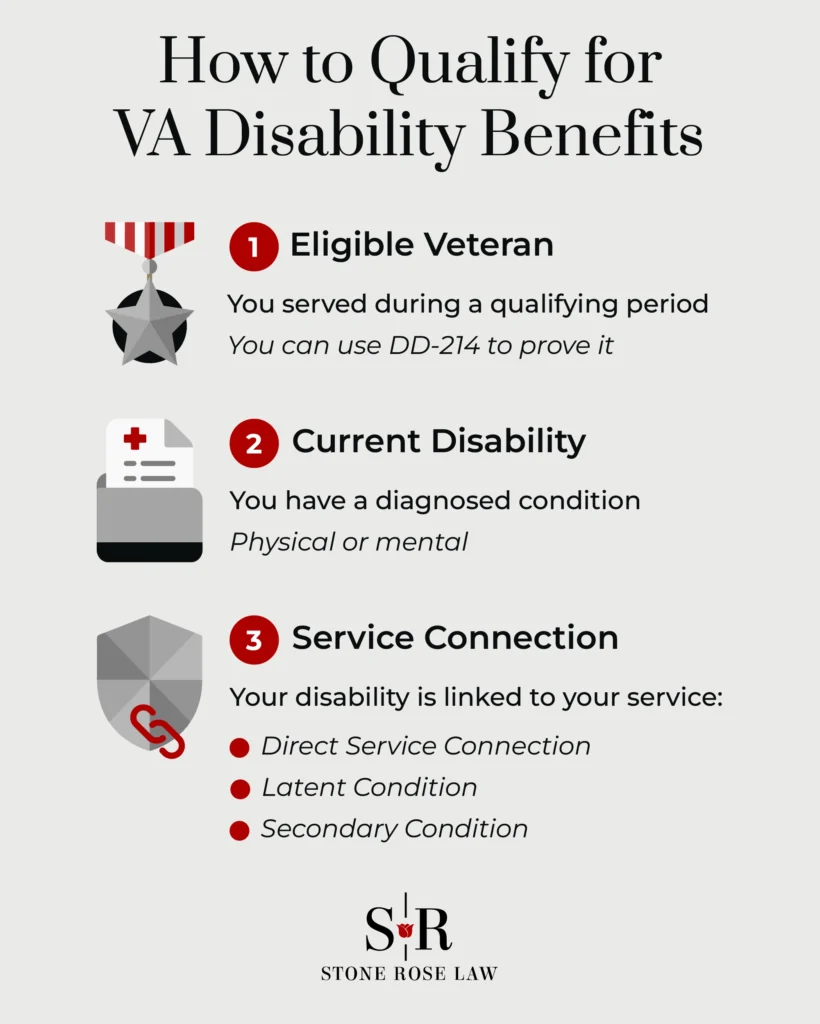
To qualify as a veteran eligible to receive VA benefits, your active duty service must fall within a time period the VA recognizes. You can usually establish this through your military service records, including your DD Form 214.
If you’ve received a dishonorable discharge or an other-than-honorable discharge, it may be better to first see if you can work with an experienced VA benefits attorney to improve your discharge by appealing to the VA.
The VA defines a disability as a current physical or mental illness or impairment that your active duty military service either caused or made worse.
You may be eligible for compensation from the VA if your service-related disability makes you less than 100% able-bodied, which can be proven with medical records.
The VA decides whether you have a service-connected disability on a case-by-case basis. Your service medical records and any records of post-service medical treatment you have received will be part of the claims evidence the VA will consider.
While certain medical conditions, known as presumed disabilities, do not require proof of a military service connection, most conditions still require evidence of a service connection.
The VA rejects many disability claims because they lack sufficient evidence to create a service connection.
One of our Delaware VA disability attorneys at Stone Rose Law can help you gather all the necessary documents and evidence to overcome this potential obstacle.
What follows are some specific medical conditions the VA will consider in addition to disabilities that arose directly because of a service-connected disabling event.
A latent condition is one you had when you entered military service, but has not yet become disabling.
If your latent condition becomes worse after you leave the service, the VA will decide whether an event connected to your service aggravated the condition.
Another way you can receive a service-connected disability is if it comes from a separate disability that itself is service-connected.
For example, your doctor might diagnose you as having post-traumatic stress disorder (PTSD) based on a traumatic event you experienced while in service. If your PTSD treatment includes drugs that have a side effect of contributing to significant weight gain, this additional weight could eventually cause you to be diagnosed with Type 2 Diabetes.
These events make it possible to trace a secondary service connection by showing that the PTSD treatment caused your diabetes.
The VA will deny your claim if your injury, illness, or disabling condition results from doing something unrelated to a service-connected condition.
If the VA approves your initial or additional disability compensation claim, it will assign you a VA disability rating. Your rating will range from 0% (non-compensable) to 100% for totally disabled veterans.
Factors that go into deciding your disability rating include whether you have multiple disabilities (most veteran claims are for more than one disability) and the severity of each disability.
The VA uses a formula to determine your combined disability rating if you have more than one disability. The VA calculations use a complex collection of tables in a process some call “VA Math” to arrive at a final combined figure.
One of our Stone Rose Law VA lawyers can help you understand and demonstrate the extent and degree of your disability to achieve the disability compensation you need.
Our VA Disability Calculator can help you estimate how much you may receive in monthly disability payments if you have multiple disabilities.
How much you can receive in monthly disability benefits compensation depends on your single or combined disability rating. The higher your overall disability rating, the more you can receive.
For 2026, the disability rating compensation for an individual veteran is as follows:
| Combined VA Disability Rating | 2026 Monthly Compensation |
| 10% | $180.42 |
| 20% | $356.66 |
| 30% | $552.47 |
| 40% | $795.84 |
| 50% | $1,132.90 |
| 60% | $1,435.02 |
| 70% | $1,808.45 |
| 80% | $2102.15 |
| 90% | $2,632.30 |
| 100% | $3,938.58 |
These monthly payments increase for disabled veterans with dependents.
If you have one or more dependents, and your combined disability rating is at least 30%, you can qualify for additional monthly compensation depending on how many qualifying dependents you have.
A qualifying dependent can include:
Special monthly compensation (SMC) is available if you are a disabled veteran whose service-connected disability is severe enough that you need more than what a 100% disability rating provides.
SMC is available based on criteria such as specific disabilities (e.g., loss of a limb or creative organ), need for regular aid and attendance, permanent housebound status, or traumatic brain injury requiring ongoing assistance.
Except for SMC category K, SMC benefits replace the monthly compensation benefit you would otherwise receive.
The VA rates SMC benefits through the letters K, L, M, N, O, P, R, S, and T.
Here are the 2026 SMC compensation amounts.
| SMC Category | 2026 SMC Monthly Benefit | Notes |
| K | $139.87 | Paid in addition to your 100% monthly disability compensation |
| L | $4,900.82 | |
| L-½ | $5,154.17 | |
| M | $5,408.56 | |
| M-½ | $5,780.19 | |
| N | $6,152.64 | |
| N-½ | $6,514.55 | |
| O and P | $6,877.12 | No difference in pay between these two categories |
| R-1 | $9,826.88 | |
| R-2 and T | $11,271.67 | No difference in pay between these two categories |
| S | $4,408.52 |
If you are a qualifying surviving dependent of a veteran whose death was caused by that person’s military service, you may be eligible for dependency and indemnity compensation (DIC).
The base DIC monthly compensation amount for 2026 is $1,699.35.
This amount can increase based on factors like whether the deceased veteran was totally disabled, whether a surviving spouse requires aid and attendance services or is housebound because of a disability, and whether a surviving spouse has children under age 18.
There are multiple special VA veteran benefits for which you may be eligible.
For example, if you cannot find or keep substantially gainful employment, you may be able to receive additional VA benefits based on individual unemployability.
You might also receive compensation for costs if you need hospital or convalescent care, or assistance with paying for transportation and clothing.
A Stone Rose Law Delaware veterans disability attorney can help you learn which may apply to your needs.
In addition to the VA’s veterans benefits, the state of Delaware also offers its own benefits for veterans.
Note that the state benefits below are not all the Delaware benefits you can claim; we only cover those that apply to Delaware disabled veterans.
The listing below may not be comprehensive of all possible state benefits for which you may qualify. An experienced Delaware veterans disability benefits lawyer can help you know which state veterans benefits you may be eligible to receive.
A paraplegic veteran can receive a state pension of $3,000 per year. The veteran must file evidence with the Pension Office stating that they are paraplegic and fully disabled, and the disability is a direct result of their wartime military service.
Qualified disabled veterans who have a service-connected, permanent and total disability based on individual unemployability or a 100% disability rating from the VA and who have maintained a domicile in Delaware for the past three years may be eligible for a tax credit against 100% of non-vocational school district property tax assessed on a primary residence.
Disabled Veteran Hiring Preference
Delaware offers Veterans’ hiring preference to disabled Veterans and certain spouses for state employment. Honorably discharged Veterans or reserve component service members who have a service-connected disability are eligible for 10 points, as are spouses of veterans who have service-connected disabilities.
Disabled Veterans who have a specially adapted vehicle to accommodate their disability, which was purchased or modified with funds from the VA, are eligible for an exemption of registration fees (limited to one automobile).
Disabled Veterans are eligible for the Delaware Disabled American Veteran license plate. Applicants are charged a $10 administrative fee for this license plate.
Veterans must have a VA service-connected disability they received during a time of war or conflict. Surviving spouses may retain this license plate upon the veteran’s death.
The Department of Natural Resources and Environmental Control, Division of Fish and Wildlife, issues an exemption from hunting, trapping, and fishing licenses to qualifying disabled veterans who have received an honorable discharge and have a service-connected disability rating of 60% or higher from the VA.
At Stone Rose Law, our Delaware VA disability lawyers systematically approach your specific VA claim. After your consultation with an accredited VA disability benefits attorney and with your permission, our attorneys will obtain a copy of your VA claims file.
Because our attorneys have access to the same systems the VA uses to maintain claims files, we can obtain your claims file quickly.
Once we access your claims file, we review all the information contained within it. This involves reviewing all your service treatment records, VA records, previous claims for benefits, and rating decisions.
We thoroughly scour your records to look for:
After reviewing your file and creating a plan for your initial claim, we will discuss our findings and recommendations with you.
If you have never applied for VA benefits before, we will assist you at no cost in preparing and filing a claim. We will also monitor your claim, assist you with preparing for C&P examinations, and advise you of any VA decisions as part of this free service.
If you are denied VA benefits or believe your VA rating decision awarded you insufficient benefits, we can also help you fight for your benefits through a compelling appeal of the initial VA decision.
You can schedule a free case evaluation with a Delaware veterans VA disability lawyer by calling (480) 498-8998 or using our contact form.