
If you’re facing unlawful harassment at work, you may have legal grounds to take action. Filing a formal complaint can be the first step toward holding your employer accountable and protecting your job.
At Stone Rose Law, we help Arizona employees understand their rights, report harassment to the proper authorities, and navigate the complex complaint process. Call (480) 535-9003 today to speak with an experienced employment law attorney.
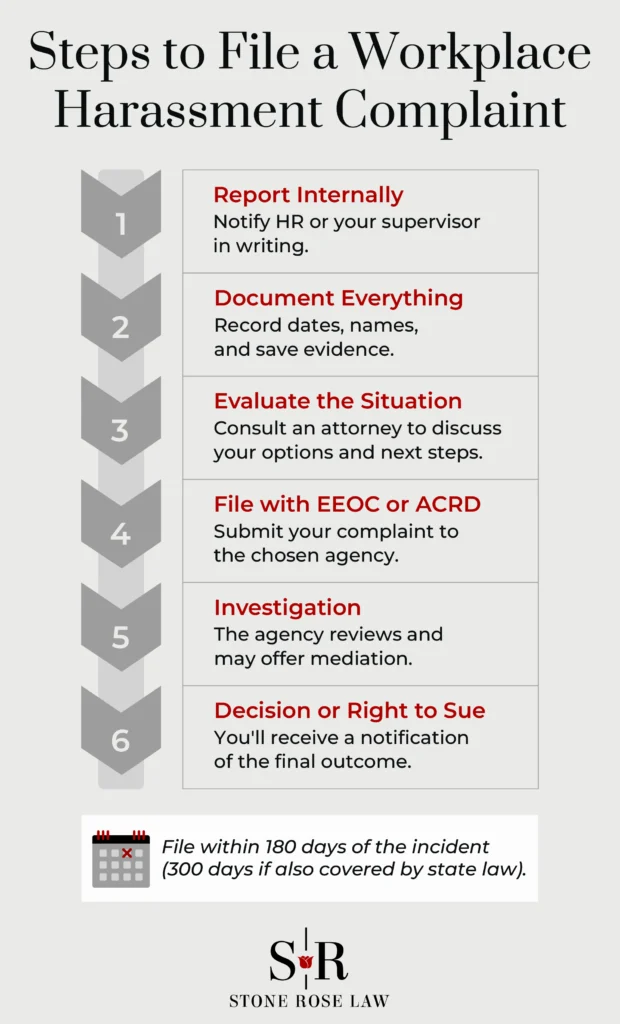
Filing harassment charges in Arizona involves several important steps. It typically starts with reporting the harassment to your employer, followed by filing a formal complaint with a state or federal agency.
In some cases, it may lead to legal action against the harasser or the employer.
To protect your rights, document each incident of harassment in detail. Write down dates, times, names of individuals involved, and any witnesses.
Save messages, emails, or physical evidence. These records may be critical later during a workplace harassment investigation or lawsuit.
An experienced employment lawyer can help you understand whether your situation meets the legal definition of harassment and can guide you through the correct steps.
Before filing a legal complaint, employees are generally expected to report harassment internally. That includes notifying your immediate supervisor, human resources (HR), or another designated person according to your workplace’s anti-harassment policy.
Make sure your report is in writing. Use clear, professional language and include as many facts as possible.
Reporting harassment does not require you to use legal terms, but the more information you provide, the easier it is for the company to investigate.
Under federal law, if you don’t first report the conduct internally, your employer may argue that they were not given a chance to resolve the issue.
If your employer fails to take appropriate action (or if the harassment continues), you may need to file a formal complaint with a government agency. In Arizona, employees may file with either the:
The agency you choose depends on the nature of the complaint and how many employees the employer has. Most cases must go through this process before you can file a lawsuit.
Only certain individuals are protected under anti-discrimination laws. You must be part of a protected class, such as based on race, religion, age (40 and over), sex, disability, national origin, or genetic information.
The harassing behavior must also be linked to that characteristic. For example, a co-worker being rude to everyone isn’t harassment under the law, but if they are only abusive to women or to people of a certain religion, that may be unlawful.
Both federal and Arizona law prohibit harassment in the workplace. However, some laws only apply if the employer has a minimum number of employees:
Federal employees must go through an internal EEO counselor before filing with the EEOC. That means the process is different for government workers.
If you’re experiencing harassment, take these steps immediately:
Do not delay. There are strict deadlines for filing harassment complaints.
In most cases, you must file within 180 days of the last incident, though that may be extended to 300 days in Arizona if state law also applies.
Filing a harassment complaint is not just about paperwork—it’s about protecting your job, your mental health, and your future. Many employees are afraid to speak up, fearing retaliation, termination, or isolation at work.
A skilled attorney can help:
Hiring a lawyer also means you don’t have to navigate complex legal rules alone. Your attorney becomes your advocate throughout the process, from your first report to potential resolution or litigation.
If you’ve experienced harassment at work, don’t wait. Contact Stone Rose Law at (480) 535-9003 to schedule a consultation.
We can help you understand your rights, protect your job, and file a harassment complaint that gets taken seriously. Let us help you take back control of your workplace.