The US Department of Veterans Affairs (VA) recognizes certain shoulder conditions, and their ratings can range from 10% to 100% depending on how much the injury limits your arm.
A shoulder condition may qualify for VA disability benefits when it is connected to military service or to another service-connected condition.
The VA may rate a shoulder disability based on range of motion, ankylosis, dislocation, instability, muscle injury, shoulder replacement, or the difference between the dominant arm and non-dominant arm. A shoulder pain VA rating may also depend on what happens during a C&P exam and whether the medical evidence supports service connection.
Stone Rose Law helps veterans with VA claims, denied claims, rating disputes, and appeals.
Call Stone Rose Law at (480) 498-8998 or use our online contact form for a free consultation about your VA shoulder disability rating.
For 2026, monthly VA compensation for a single veteran with no dependents is:
| Combined VA Disability Rating | 2026 Monthly Compensation |
| 10% | $180.42 |
| 20% | $356.66 |
| 30% | $552.47 |
| 40% | $795.84 |
| 50% | $1,132.90 |
| 60% | $1,435.02 |
| 70% | $1,808.45 |
| 80% | $2,102.15 |
| 90% | $2,362.30 |
| 100% | $3,938.58 |
These amounts may increase if the veteran has a spouse, dependent children, or dependent parents. A veteran with multiple service-connected disabilities may receive a different combined rating than the rating assigned for shoulder pain alone. You can always use our VA disability calculator to learn more.
The VA rates many shoulder disabilities under 38 C.F.R. § 4.71a, often searched as 38 CFR 4.71 or 38 CFR 4.71a, while shoulder muscle injuries may be rated under 38 CFR 4.73.
Most shoulder ratings focus on how the condition affects arm use. This can include pain, limited range of motion, weakness, instability, dislocation, ankylosis, or damage to the humerus, clavicle, or scapula.
Shoulder Disability Ratings at a Glance (38 C.F.R. § 4.71a)
| Diagnostic Code | Condition | Severity | Major (dominant) arm | Minor (non-dominant) arm |
|---|---|---|---|---|
| DC 5200 | Ankylosis of the shoulder | Favorable (abduction to 60°, can reach mouth/head) | 30% | 20% |
| Intermediate | 40% | 30% | ||
| Unfavorable (abduction limited to 25° from the side) | 50% | 40% | ||
| DC 5201 | Limitation of arm motion | At shoulder level (flexion/abduction to 90°) | 20% | 20% |
| Midway between side and shoulder level (45°) | 30% | 20% | ||
| Limited to 25° from the side | 40% | 30% | ||
| DC 5202 | Humerus impairment | Malunion, moderate deformity | 20% | 20% |
| Malunion, marked deformity | 30% | 20% | ||
| Recurrent dislocation, guarding at the shoulder level | 20% | 20% | ||
| Recurrent dislocation, guarding of all arm movements | 30% | 20% | ||
| Fibrous union | 50% | 40% | ||
| Nonunion (false flail joint) | 60% | 50% | ||
| Loss of the head of the humerus (flail shoulder) | 80% | 70% | ||
| DC 5203 | Clavicle or scapula impairment | Malunion | 10% | 10% |
| Nonunion without loose movement | 10% | 10% | ||
| Nonunion with loose movement | 20% | 20% | ||
| Dislocation | 20% | 20% |
The major (dominant) arm generally receives the same or a higher rating than the minor (non-dominant) arm. Your actual rating depends on the medical evidence and your C&P exam findings.
The dominant arm distinction matters because some VA shoulder ratings are higher for the major arm than the minor arm, and the VA should not rate the non-dominant arm by mistake.
Veterans should make sure the C&P exam correctly identifies the affected side. If the VA treats the major arm as the non-dominant arm, the rating decision may be wrong.
During a C&P exam, the examiner may measure shoulder range of motion (ROM) with a goniometer. Accurate range-of-motion testing can help show how shoulder pain affects lifting, reaching, and arm use.
Shoulder ROM testing may include:
The VA should consider more than the final number on a range-of-motion test. Pain, weakness, fatigue, instability, flare-ups, and limited range of motion after repeated use may all affect the VA disability rating for shoulder pain.
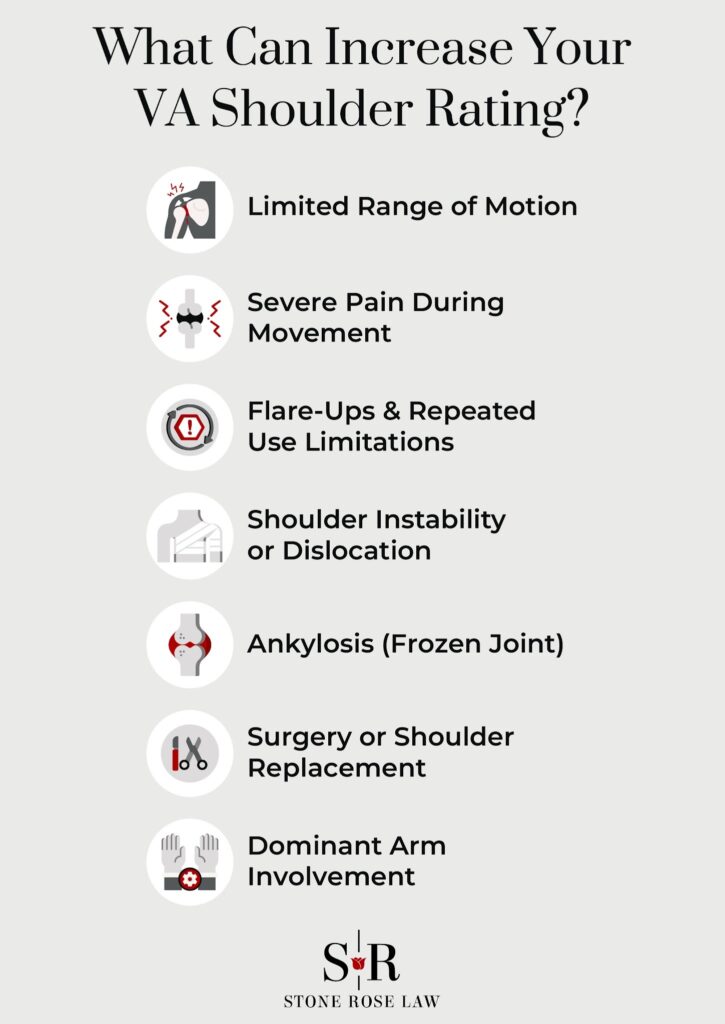
Under DC 5201, the VA rates the limitation of motion of the arm based on how far the veteran can raise the arm. Ratings can depend on whether motion is limited at the shoulder level, midway between the side and the shoulder level, or very close to the side.
This is one reason accurate range-of-motion testing is important, especially when shoulder pain worsens with repeated use.
Range-of-motion findings can also indicate whether shoulder pain limits arm movement before it reaches shoulder level.
Ankylosis means the joint is fixed, frozen, or unable to move normally. For shoulder ratings, ankylosis is addressed under DC 5200.
Favorable and unfavorable ankylosis may result in different ratings depending on the joint’s position.
Ankylosis can lead to a higher shoulder VA rating than ordinary painful motion. The rating may depend on whether the condition affects the major arm or minor arm and whether the ankylosis is favorable, intermediate, or unfavorable.
Frozen shoulder, also called adhesive capsulitis, may cause severe stiffness and limited range of motion.
DC 5202 applies to impairment of the humerus. This may include recurrent dislocation, malunion, fibrous union, nonunion, or loss of the head of the humerus.
The VA rating may depend on how often the joint comes out of place, whether guarding occurs only at shoulder level or with all arm movements, and whether the condition affects the major or minor arm.
DC 5203 applies to impairment of the clavicle or scapula. This may involve dislocation, nonunion, or malunion.
If the symptoms are better captured by limitation of motion, the VA may rate the condition based on functional impairment rather than the bone code alone.
Some shoulder and arm conditions involve muscle injury rather than only joint injury. The VA rates shoulder girdle and arm muscle injuries under 38 C.F.R. § 4.73. These ratings may depend on the affected muscle group and whether the disability is slight, moderate, moderately severe, or severe.
The VA may consider loss of strength, fatigue, pain, scarring, tissue loss, and functional impairment.
The VA generally should not compensate the same symptom twice under different codes. However, separate ratings may be possible when different manifestations are involved.
Shoulder surgery may support a temporary 100% rating when the surgery is for a service-connected shoulder condition and requires at least one month of convalescence.
Shoulder surgery may involve rotator cuff repair, labral repair, shoulder stabilization, or other procedures. Veterans should submit surgery records, discharge instructions, physical therapy records, work restrictions, and follow-up treatment notes.
Shoulder replacement is rated under DC 5051. A total shoulder replacement may receive a 100% rating for one year following implantation of the prosthesis. After that period, the VA rates the remaining symptoms. Severe painful motion or weakness may support a higher rating, while intermediate residuals are rated by analogy to DC 5200 and DC 5203.
Common service-connected shoulder conditions include:
Many types of shoulder conditions can support a VA claim.
The rotator cuff is a group of muscles and tendons that help hold the shoulder joint. A rotator cuff tear can cause pain, weakness, limited range of motion, and trouble lifting, reaching, carrying, or sleeping on the affected side.
The VA may rate a rotator cuff tear based on limitation of motion, painful motion, weakness, surgery, or other shoulder impairment. A nexus letter may help establish a connection between the injury and military service when the connection is disputed.
Shoulder impingement occurs when tissues in the shoulder become compressed during movement. A shoulder impingement VA rating may depend on how much the condition limits motion, strength, and daily function.
Bursitis and tendonitis can cause inflammation, tenderness, stiffness, and pain with movement. These conditions may overlap with rotator cuff problems, impingement syndrome, arthritis, or other shoulder injuries.
Frozen shoulder can make the joint stiff and difficult to move in several directions, including flexion, abduction, and rotation. A labral tear or SLAP tear can affect shoulder stability and may cause pain, popping, clicking, weakness, or difficulty with overhead movement.
To qualify for VA disability benefits for shoulder pain, the veteran usually needs three things:
Secondary service connection may apply when another service-connected condition causes or worsens shoulder pain or another shoulder condition.
This evidence links the current shoulder disability to military service or another service-connected disability. The VA may deny a claim when the record does not clearly explain that connection.
A nexus letter can help explain why the veteran’s shoulder condition is at least as likely as not related to service. The letter should address the diagnosis, service history, symptoms, imaging, treatment, and any relevant physical demands during military service.
For a secondary service connection, medical evidence should explain how the service-connected disability caused or aggravated the shoulder condition.
A C&P exam is a Compensation and Pension exam used by the VA to evaluate the shoulder condition.
The examiner may test flexion, abduction, internal rotation, external rotation, and whether pain begins before the end of motion.
Veterans should explain flare-ups, work limits, lifting limits, sleep problems, and whether the condition affects the dominant arm.
A service-connected shoulder disability may support Total Disability based on Individual Unemployability if shoulder pain prevents substantially gainful employment.
A veteran may qualify for schedular TDIU with one service-connected disability rated at least 60%, or a combined rating of at least 70% with one disability rated at least 40%. Some veterans may still pursue extraschedular TDIU if service-connected disabilities prevent substantially gainful employment but do not meet those percentage thresholds.
The VA may deny a shoulder claim if the record does not show a current diagnosis, an in-service event, or a nexus connecting the condition to service. The VA may also assign a low rating if the C&P exam does not fully describe ROM limitations, flare-ups, pain, instability, or dominant-arm involvement.
Common problems include:
Veterans may appeal a denial, challenge a low rating, or file for an increased rating. The best option depends on the rating decision, medical evidence, deadlines, and claim history.
A shoulder pain VA rating can affect monthly compensation, future claims, and related ratings for arm symptoms, muscle injuries, surgical residuals, or bilateral shoulder conditions. The correct rating may depend on range of motion, ankylosis, muscle injury, whether the dominant arm is affected, and whether symptoms limit the arm at shoulder level.
Stone Rose Law helps veterans challenge denied claims, seek higher ratings, and address VA rating errors involving shoulder disabilities. A VA attorney can review your C&P exam, medical records, rating decision, service connection evidence, and possible secondary service connection.
Our team can help you understand your VA rating for shoulder pain, shoulder VA disability rating issues, and your options for pursuing VA benefits for a service-connected shoulder condition.
Call Stone Rose Law at (480) 498-8998 or use our online contact form for a free consultation about your VA shoulder disability rating.