The U.S. Department of Veterans Affairs (VA) can recognize erectile dysfunction and female sexual arousal disorder as service-connected conditions, even when the schedule assigns a 0% rating. Veterans may still qualify for Special Monthly Compensation based on loss of use of a creative organ.
Stone Rose Law helps veterans with VA disability claims, denied claims, rating disputes, and appeals.
Call Stone Rose Law at (480) 498-8998 or use our online contact form for a free consultation about your erectile dysfunction VA rating, FSAD claim, or possible compensation.
The VA may recognize erectile dysfunction and female sexual arousal disorder as VA disabilities when the veteran proves service connection. This means the condition must be linked to military service, another service-connected disability, or treatment for that disability.
However, the VA does not usually pay standard monthly disability compensation for either condition by itself.
Under the current schedule, Diagnostic Code 7522 assigns a 0% rating for erectile dysfunction, with or without penile deformity, and Diagnostic Code 7632 assigns a 0% rating for female sexual arousal disorder. Veterans may still qualify for Special Monthly Compensation when a loss of use affects reproductive function.
That means erectile dysfunction or female sexual arousal disorder can carry a 0% rating and still support additional monthly compensation. This is why a non-compensable rating can still have financial value.
The VA rates erectile dysfunction and related male reproductive conditions under Diagnostic Codes 7520 through 7524. These codes address different forms of anatomical loss, testicular atrophy, testicular loss, and erectile dysfunction.
Current VA ratings may include:
These ratings mean an ED VA rating can fall within a broader reproductive-system range of 0% to 30%, depending on whether the claim involves erectile dysfunction alone, anatomical loss, testicular atrophy, testicular loss, deformity, or another affected body part. A VA rating for erectile dysfunction may also lead to SMC-K when there is a loss of use of a creative organ.
The VA usually rates female sexual arousal disorder under Diagnostic Code 7632. Under the current schedule, the female sexual arousal disorder VA rating is 0%.
A 0% rating is non-compensable, meaning it does not pay standard monthly VA disability compensation on its own. However, a non-compensable FSAD rating can still matter if the condition is linked to service and supports additional compensation.
If there is physical damage to the genitals or another separately ratable condition, the VA may evaluate that damage under the diagnostic code for the affected body part. A VA attorney can review whether the female sexual arousal disorder VA rating should involve FSAD alone, another gynecological code, Special Monthly Compensation, or all available theories.
To qualify for VA disability benefits for erectile dysfunction or female sexual arousal disorder, the veteran usually needs three things:
Veterans may also qualify through secondary service connection. For example, erectile dysfunction or FSAD may be linked to PTSD, depression, chronic pain, medication side effects, or treatment for another service-connected condition.
Even if the rating is non-compensable, the VA claim can still matter. A 0% rating may support SMC-K, preserve the issue for later, and help document the veteran’s full disability picture.
Service connection is the legal link between the veteran’s condition and military service. For erectile dysfunction or female sexual arousal disorder, direct service connection may apply when symptoms began during service or developed because of service-related physical or psychological events.
Depending on the facts, that may involve pelvic trauma, groin injury, nerve damage, hormonal changes, treatment during service, military sexual trauma, or other service-related events.
A claim may also be based on aggravation. If a condition affecting sexual function existed before service but became worse because of military service, the veteran may still have a valid claim. Even when the final rating is non-compensable, proving the link can still matter because it may support added compensation and preserve the issue for future review.
Secondary service connection may apply when erectile dysfunction or female sexual arousal disorder is caused or worsened by another service-connected disability. This is common because sexual dysfunction often develops as a result of other physical or mental health conditions rather than as a standalone condition.
Erectile dysfunction secondary to PTSD is a common VA claim theory. A VA rating for erectile dysfunction secondary to PTSD may depend on medical evidence showing that PTSD symptoms, PTSD treatment, mood symptoms, sleep disruption, or medication side effects caused or aggravated the erectile dysfunction.
Female sexual arousal disorder may be connected to military service, trauma, military sexual trauma, chronic pain, medication side effects, or another service-connected condition. Other secondary theories may involve back injuries or other service-connected conditions that affect hormones, circulation, nerve function, pain levels, or sexual response.
The VA does not automatically grant secondary service connection. The claim usually needs medical evidence connecting the primary disability to the sexual dysfunction and explaining how the underlying condition, treatment, or side effects caused or worsened the condition.
Erectile dysfunction and female sexual arousal disorder can have many causes. Some are physical, some are psychological, and some come from treatment for another condition.
Conditions that may support a VA claim include:
The specific medical chain matters. Veterans should be able to explain what service-connected condition came first, what symptoms or treatment followed, and how erectile dysfunction or female sexual arousal disorder developed.
A nexus is the medical link between military service, a VA-recognized disability, and the current sexual dysfunction. The VA may deny a claim when the record does not clearly explain that connection.
A nexus letter can help show that erectile dysfunction or FSAD is at least as likely as not related to service or to another qualifying disability. The letter should discuss the veteran’s diagnosis, medical history, treatment history, PTSD, depression, and any relevant injuries.
For a VA disability erectile dysfunction claim, the nexus letter should also address whether there is loss of erectile power and whether the veteran may qualify for SMC-K. For female sexual arousal disorder, the letter should explain the symptoms, diagnosis, and whether the condition may support Special Monthly Compensation.
A C&P exam is a Compensation and Pension exam used by the VA to evaluate a disability claim. For erectile dysfunction or female sexual arousal disorder, the examiner may ask about symptoms, onset, diagnosis, treatment history, mental health history, physical injuries, and related service-connected conditions.
Veterans should explain symptoms clearly. This may include loss of erectile power, reduced libido, arousal problems, pain, relationship impact, and whether the condition began after PTSD, depression, or another service-connected condition.
The examiner may also review whether the veteran has physical deformity, anatomical loss, removal of reproductive organs, atrophy of the testicles, or other conditions that may affect the rating. Veterans should avoid minimizing symptoms simply because the topic is personal.
Special Monthly Compensation is additional compensation for certain losses or loss of use. For erectile dysfunction and female sexual arousal disorder, the relevant benefit is usually SMC-K for loss of use of a creative organ.
Loss of use of a creative organ may include loss of erectile power, infertility, sterility, or another service-connected loss affecting reproductive function. For erectile dysfunction, loss of erectile power can itself qualify as loss of use of a creative organ, so SMC-K may apply even with a 0% rating.
Female sexual arousal disorder works differently. A 0% FSAD rating does not, by itself, qualify for SMC-K. The veteran must show a loss of use of a reproductive organ (for example, documented infertility, sterility, or loss of reproductive function) not arousal difficulty alone. A VA attorney can review whether the medical evidence supports a loss-of-use claim.
The current SMC-K rate is $139.87 per month, effective December 1, 2025. The VA adds that amount to the veteran’s basic disability compensation rate in most cases. Veterans should check the most recent VA rate table before relying on an older SMC-K amount.
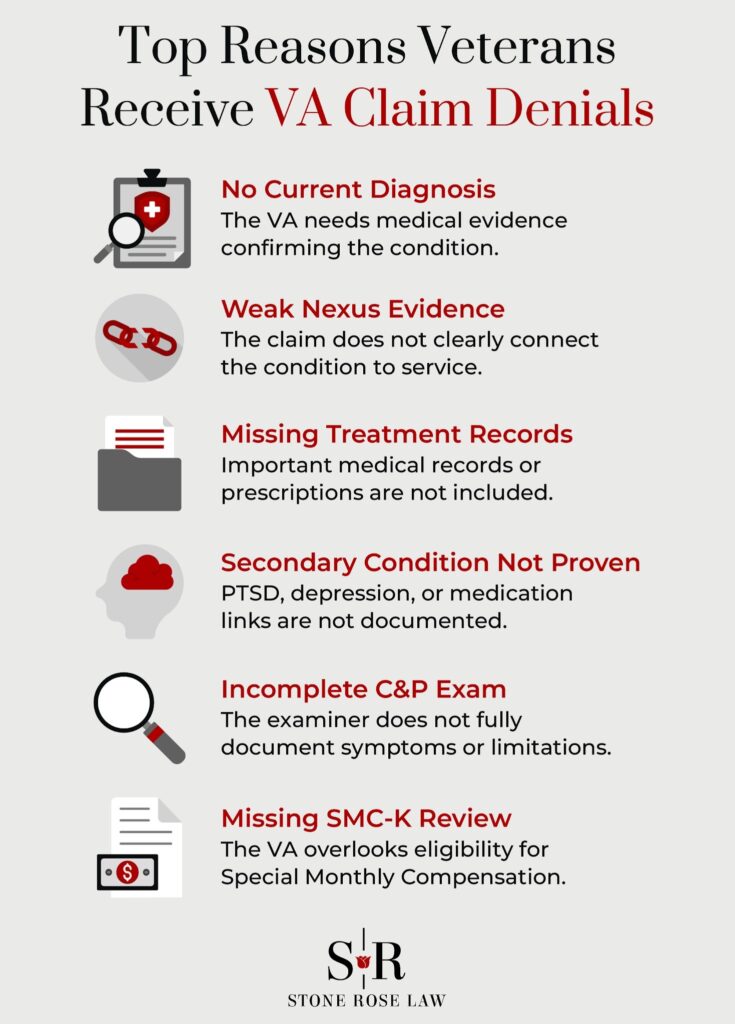
The VA may deny an erectile dysfunction or female sexual arousal disorder claim when the record does not show a diagnosis, service connection, or nexus. The VA may also overlook SMC-K even when the veteran has loss of use of a creative organ.
Common problems include:
A denied claim may still be challenged. The best next step depends on the rating decision, evidence, deadlines, and whether the VA failed to address Special Monthly Compensation or service connection.
Erectile dysfunction and female sexual arousal disorder are personal medical issues, but they can also be VA disability issues. If the condition is linked to military service, secondary to PTSD, linked to depression, caused by medication side effects, or related to another disability, the veteran may qualify for VA benefits.
Stone Rose Law helps veterans challenge denied claims, pursue secondary service connection, seek Special Monthly Compensation, and review a VA rating for erectile dysfunction or female sexual arousal disorder. A VA attorney can review your medical records, C&P exam, medical-link evidence, rating decision, and possible loss of use of a creative organ.
Call Stone Rose Law at (480) 498-8998 or use our online contact form for a free consultation.